Quick Answer
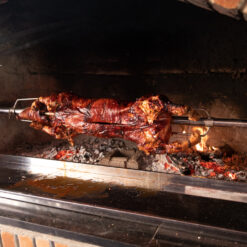
A 40 to 60-pound (18-27 kg) whole lamb typically takes 4 to 5 hours to roast on
a spit. Lamb is leaner than pork and more sensitive to drying out, so careful
temperature management is key to keeping it juicy.
Complete spit roasting guide
If you’re roasting a pig instead: Time by Weight: Pig
This chart provides a reliable starting point for planning your lamb roast. The “Typical
Range” is what you should plan for in most situations, while the owner-provided
range gives a practical baseline.
Time table for 40 / 50 / 60 lb lambs (and kg)
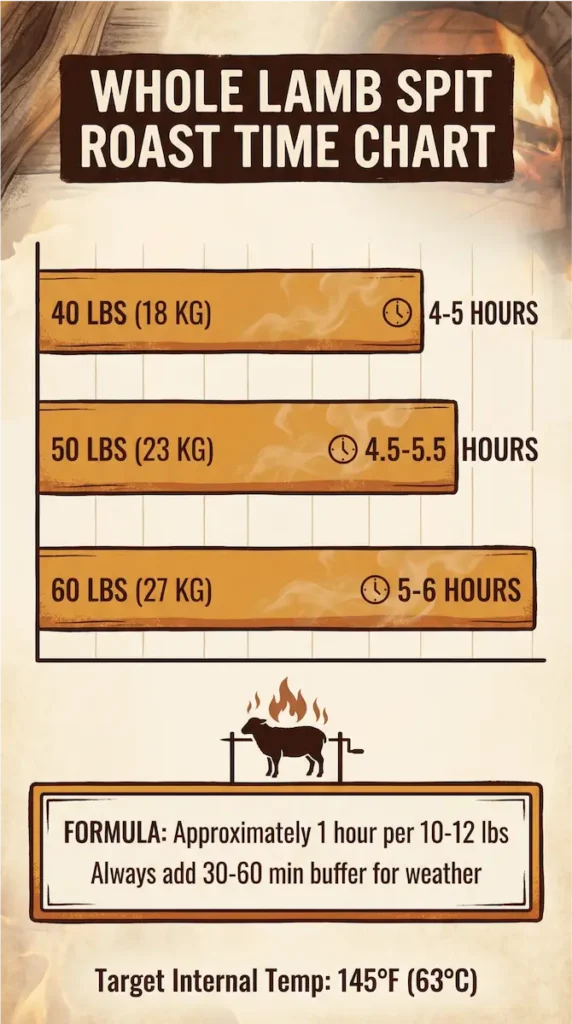
Note: The owner-provided practical range for a 40-60 lb lamb is about 4-5 hours. [2]
Why lamb timing isn’t the same as pig timing
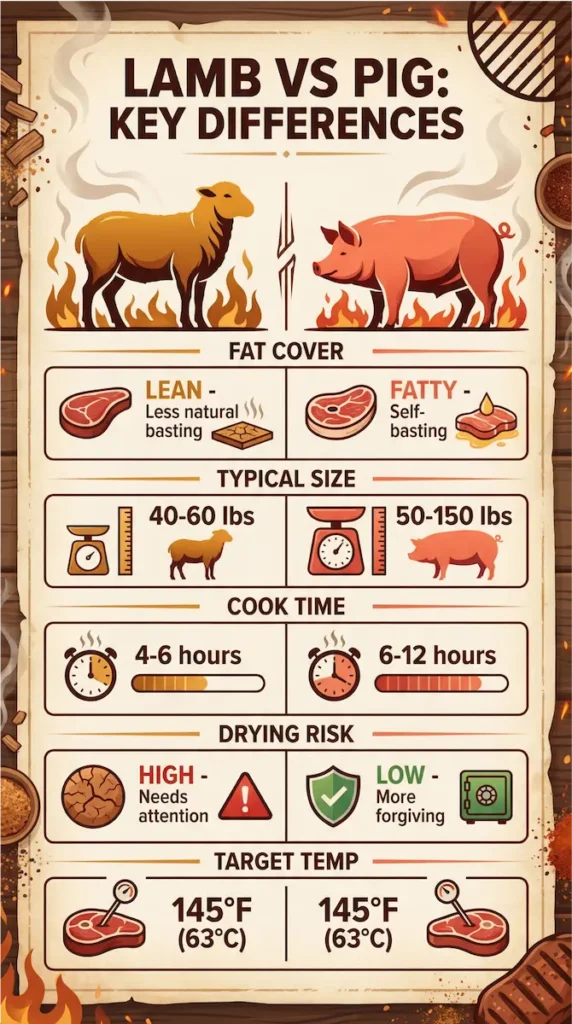
While both are fantastic on a spit, you can’t simply swap the timing between a lamb
and a pig. Lamb is naturally a much leaner animal than a pig, with significantly less
fat cover. This fat acts as a natural insulator and self-baster on a pig, allowing it to
cook for longer periods without drying out.
Lamb’s leanness makes it more vulnerable to overcooking. It requires more attention
to heat management and distance from the fire to ensure the meat stays moist and
tender. Because whole lambs are generally smaller than whole pigs, they also cook
faster overall.
For a detailed breakdown of pig roasting times, see our guide here: [Link: Time by
Weight: Pig].
While every roast is unique, a simple formula can give you a good starting point for
your timing.
Simple formula (lb → hours) + buffer
A common rule-of-thumb for spit-roasting lamb is to plan for approximately 15-20
minutes per pound. [3] This is a general guideline, and you should always add a
buffer for weather and other variables.
Formula: (Lamb Weight in lbs x 15-20 minutes) = Total Estimated Cook Time
Always add at least a 30-60 minute buffer to your plan. Wind and cold are the
biggest variables that can extend your cook time.
Example: 50 lb lamb (worked example)
Using the formula for a 50-pound lamb:
• Calculation: 50 lbs x 15 minutes/lb = 750 minutes (12.5 hours) This seems
too long based on other sources. Let’s try another formula.
Let’s use a different rule of thumb: approximately 1 hour for every 10-12 pounds.
• Calculation: 50 lbs / 10 lbs/hr = 5 hours
• Estimated Range: This gives a baseline of 5 hours. A smart planning window
would be 4.5 to 5.5 hours.
When the formula fails (and why)
• Wind and Cold: Wind can steal heat and add an hour or more to your cook
time.
• Weak Fire: An inconsistent coal bed means a fluctuating temperature, which
stalls the cooking process.
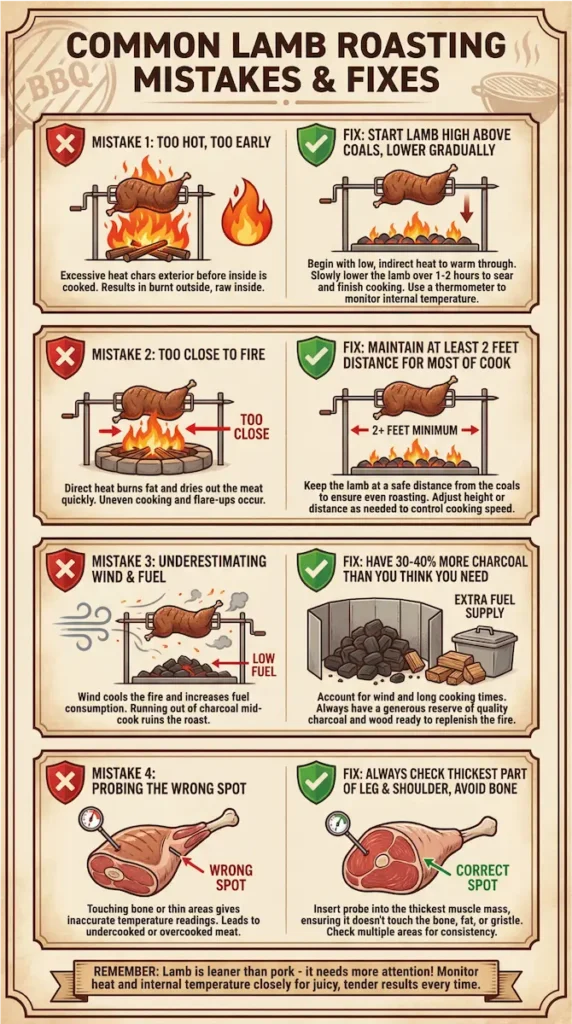
• Too Close to the Fire: This dries out the exterior before the inside is cooked.
Fire quality and stable coal bed
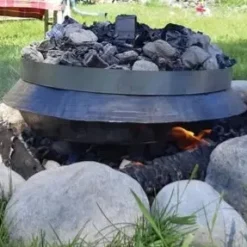
A consistent, even bed of coals is crucial for lamb. You need steady radiant heat, not
roaring flames. Plan on having enough charcoal for the entire cook.
Distance from fire + heat zones
Lamb is more delicate than pork. Start with the lamb about 2-3 feet (60-90 cm)
above the coals and lower it gradually as the fire matures. [4] [Link: Fire distance &
heat control]
Weather (wind/cold) and why lamb is sensitive
Because lamb has less insulating fat, it is more susceptible to heat loss from wind
and cold. A windy day can easily add an hour or more to your cook time.
Lamb size, fat cover, and “dressed vs live weight”
It’s critical to know the difference between “live weight” and “dressed weight.”
• Live Weight: The weight of the animal on the hoof.
• Dressed Weight (Carcass Weight): The weight after initial processing. For
lamb, this is typically 50-54% of the live weight. [5]
If you order a “100 lb lamb,” you are likely getting a 100 lb live weight animal, which
will yield a much smaller 50-54 lb carcass.
Rotation speed and even exposure
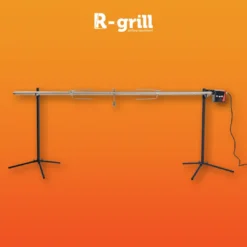
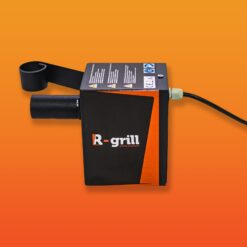
A steady, consistent rotation is key. Our R-Grill motors are designed for smooth,
powerful rotation to ensure every part of the lamb gets even exposure to the heat,
preventing hot spots and ensuring a uniform cook.
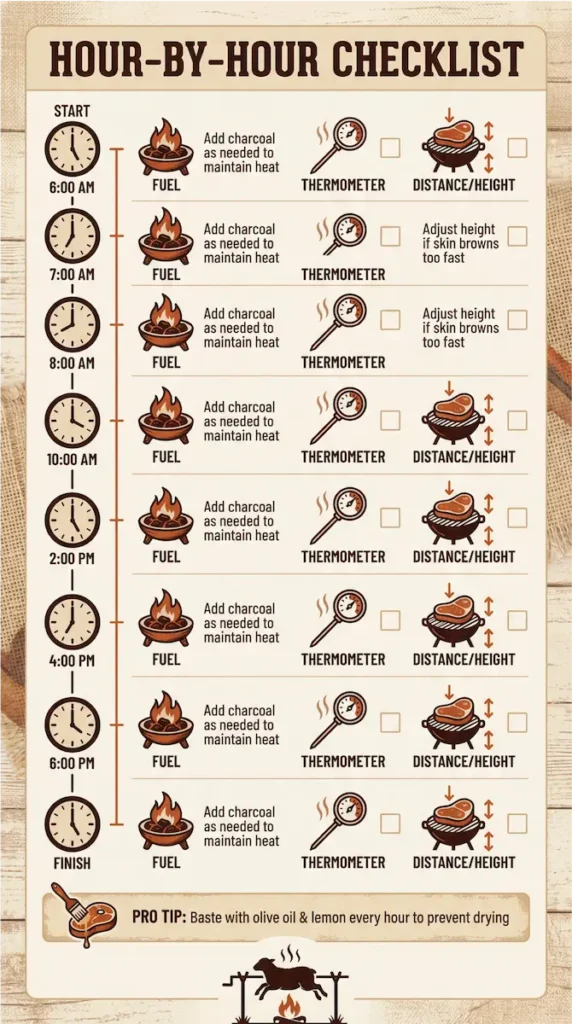
Every 60 minutes: the 3 checks that matter
1. Fuel: Check your coal bed. Add more charcoal as needed to maintain a
consistent temperature.
2. Temperature: Check the internal temperature in the thickest parts (leg and
shoulder).
3. Distance: Is the skin browning too quickly? Raise the spit. Is the cooking
stalling? Lower it slightly.
How to prevent drying out early
Basting can help. A simple mop of olive oil, lemon juice, and herbs applied every
hour or so can help keep the surface moist. Also, ensure your fire isn’t too
aggressive.
Finish window: when to crisp vs when to slow down
In the last 30-45 minutes, you can lower the lamb a bit closer to the coals to achieve
a final crisp on the skin. If it’s cooking too fast, raise it up and let it finish with gentle
heat.
Temperature Map
For an accurate reading, you must check the temperature in the thickest parts of
the meat, avoiding bone.
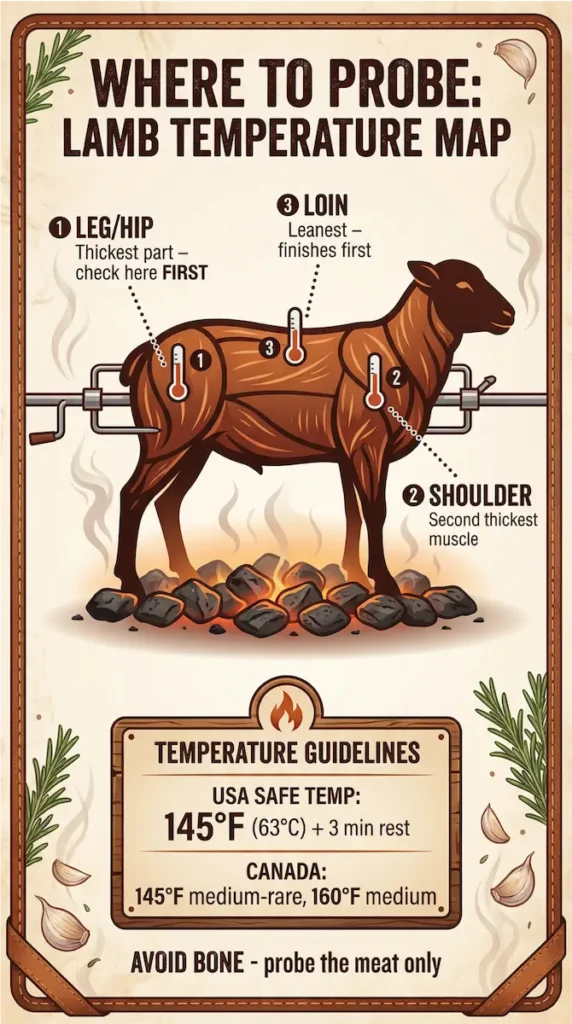
Best probe spots for whole lamb
• Leg/Hip (Thickest Part): This is the densest muscle and will be the last to
finish.
• Shoulder: The other major muscle mass to check.
• Loin: This leaner section will finish first. It’s good to monitor, but don’t pull the
lamb until the leg and shoulder are at temperature.
Safe baseline vs tenderness targets (short)
According to the USDA, lamb is safe to eat when it reaches an internal temperature
of 145°F (63°C), followed by a 3-minute rest. [6] Health Canada provides similar
guidelines, listing 145°F (63°C) for medium-rare. [7] For tenderness, especially in the
leg and shoulder, many prefer to cook to a slightly higher temperature of 150-160°F.
Thermometer-based doneness (simple rules)
A reliable meat thermometer is the only way to be sure.
• USA/Canada (Medium-Rare): 145°F (63°C) [6] [7]
• Medium: 160°F (71°C) [7]
Visual cues that help (but don’t replace probing)
• The joints will feel loose.
• The meat will start to pull back from the leg bones.
• As a helpful heuristic, some experienced pitmasters note that the dripping of
fat and juices will slow down significantly as the lamb nears doneness.
However, this is just a clue, not a replacement for a thermometer.
Resting time and carryover cooking (15–30 min)
After you remove the lamb from the heat, its internal temperature will continue to rise
by 5-10°F. This is called carryover cooking. Let the lamb rest for at least 15-20
minutes before carving. [8] This allows the juices to redistribute, ensuring a moist
and flavorful result.
FAQs (Short Answers)
Safety checklist
[Link: Safety checklist]
Sources
[1] Barbecue Tricks: Whole Lamb BBQ On a Spit.
[2] Owner-provided data.
[3] The Spruce Eats: How to Roast a Whole Lamb on a Spit (Note: Original article was
paywalled, but the time estimate is widely cited from this source).
[4] Kopiaste: Ovelias – Whole Lamb Roasted on the Spit.
[5] University of Wisconsin-Madison Division of Extension: How much meat should a lamb yield?
[6] USDA Food Safety and Inspection Service: Lamb From Farm to Table
[7] Government of Canada: Safe internal cooking temperatures.
[8] The Kitchn: Mistakes to Avoid When Cooking a Leg of Lamb.
[9] R-Grill