Quick Answer: The 3 Key Zones To know when a whole lamb is done, check
the internal temperature in the three thickest parts: the leg (thickest), the
shoulder, and the loin. Always insert the thermometer into the deepest part of
the muscle, avoiding bone, and check multiple spots to confirm. Complete
guide and Time by Weight: Lamb chart.
The Simple Rule (So You Don’t Overthink It)
Roasting a whole lamb is a balancing act. Different muscles cook at different speeds,
and the goal is to get the slowest-cooking parts done without turning the rest to
leather. The rule is simple: if the thickest, slowest-cooking muscles are ready, the
rest of the lamb is too.
Probe the thickest muscle first (leg or shoulder), then confirm with loin
Start with the leg. It’s the densest muscle and will take the longest to reach your
target temperature. Once the leg is getting close, you can begin checking the
shoulder and, finally, the loin to confirm they are also ready. This systematic
approach prevents you from pulling the lamb off the heat too early.
Why lamb finishes unevenly (lean meat + different muscle thickness)
Lamb is much leaner than pork, which means it has less fat to keep it moist and can
dry out quickly. The leg and shoulder are thick, dense muscles that take longer to
cook, while the loin is a much thinner, more delicate muscle that cooks very fast.
This is why checking only one spot is a recipe for disaster.
Temperature Map (Fast + Practical)
Think of the lamb in three main sections. Your goal is to find the thermal center—the
coolest point in the thickest part of each muscle.
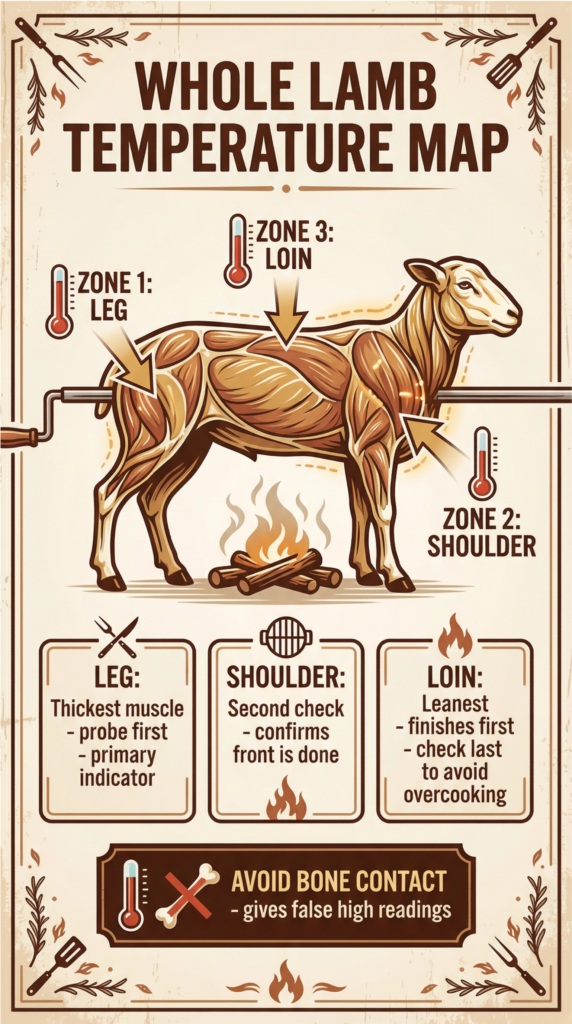
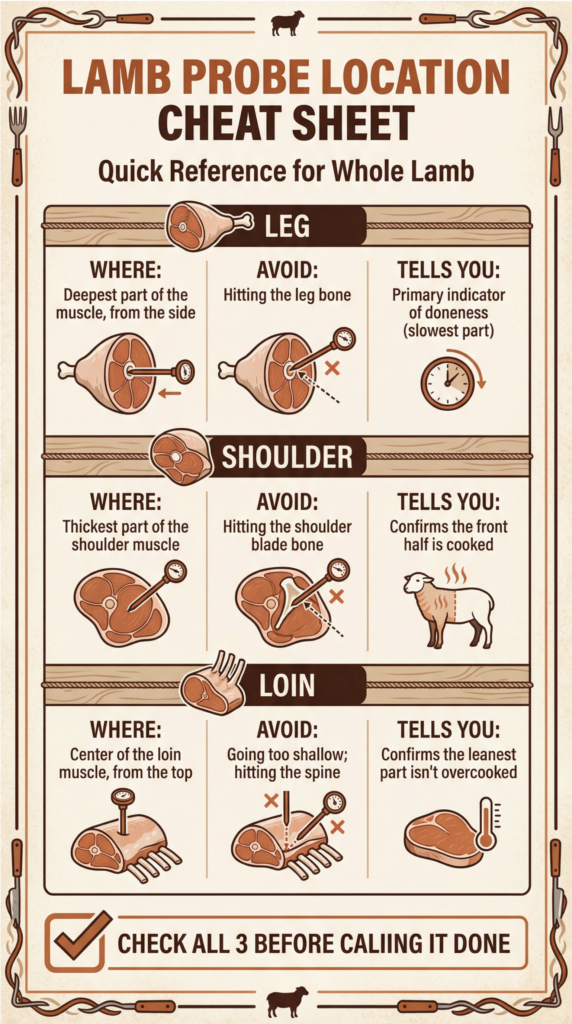
Leg (thickest) – where exactly to insert the probe
The leg is your main target. Insert your thermometer horizontally into the side of the
leg, aiming for the very center of the thickest muscle mass. Angle it slightly to ensure
you are deep within the muscle and not scraping along the surface or hitting the
large leg bone.
Shoulder – where exactly to insert the probe
Similar to the leg, probe the shoulder from the side, deep into the center of the
muscle. The shoulder is the second-largest muscle group, and confirming its
temperature is a critical secondary check.
Loin – why it finishes earlier and how to avoid overcooking it
The loin is a long, tender muscle along the lamb’s back. Because it is leaner and not
as thick as the leg or shoulder, it will reach its target temperature much sooner. You
should only probe the loin toward the end of the cook to ensure it hasn’t become dry
or overcooked while you wait for the leg to finish.
Near the bone vs center – avoiding false readings
Bone heats up faster and holds heat differently than muscle tissue. If your
thermometer touches a bone, it can give you a falsely high reading, tricking you into
thinking the meat is done when it isn’t. Always aim for the center of the thickest
muscle, well away from any bones [1].
How to Insert the Thermometer Correctly
Proper technique is just as important as having a good thermometer.
Depth, angle, and “no bone contact” rule
Insert the probe so the tip is in the very center of the muscle. If you hit bone, pull
back slightly until the tip is only touching meat. An instant-read thermometer should
be inserted at least half an inch deep, while a leave-in probe should be placed
securely in the thermal center before you even start cooking.
Instant-read vs leave-in probe (when each helps)
• Leave-In Probe: This type of thermometer is placed in the thickest part of the
leg at the beginning of the roast. Its cable runs outside the roaster to a
monitor, allowing you to track progress without opening the lid. It’s perfect for
monitoring the long, slow cook.
• Instant-Read Thermometer: This is your tool for verification. Use it during
the final stages of cooking to quickly check multiple spots (leg, shoulder, loin)
to confirm that the entire animal has reached a safe and consistent
temperature.
Safe Baseline vs “Tender”
It’s crucial to understand the difference between when lamb is safe to eat and when
it’s actually pleasant to eat.
The food-safety baseline for lamb (cite)
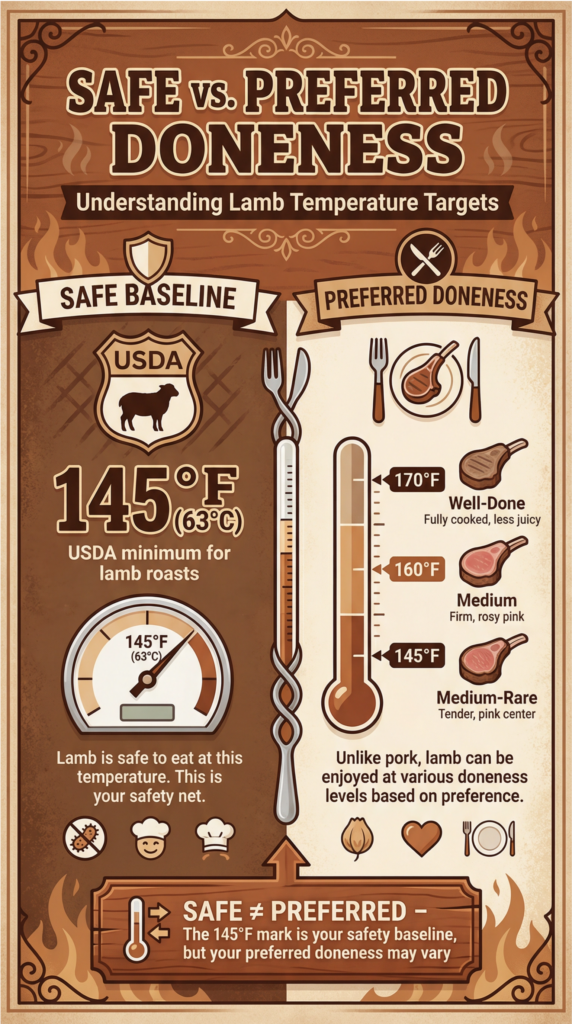
The United States Department of Agriculture (USDA) states that whole cuts of lamb,
including roasts, are safe to eat when cooked to a minimum internal temperature of
145°F (62.8°C) [2]. Health Canada provides a range, recommending 145°F for
medium-rare, 160°F (71°C) for medium, and 170°F (77°C) for well-done [1].
“Safe” doesn’t always match your preferred doneness (plain language)
While lamb is technically safe at 145°F, many people prefer it cooked to a higher
temperature for better texture and flavor. Unlike a tough pork shoulder that needs to
be cooked to a very high temperature to become tender, lamb is naturally tender and
can be enjoyed at a range of doneness levels, from medium-rare to well-done.
The 3-Check System (So You Don’t Get Fooled)
Never rely on a single reading from a single spot. Use this simple system to be
absolutely sure.
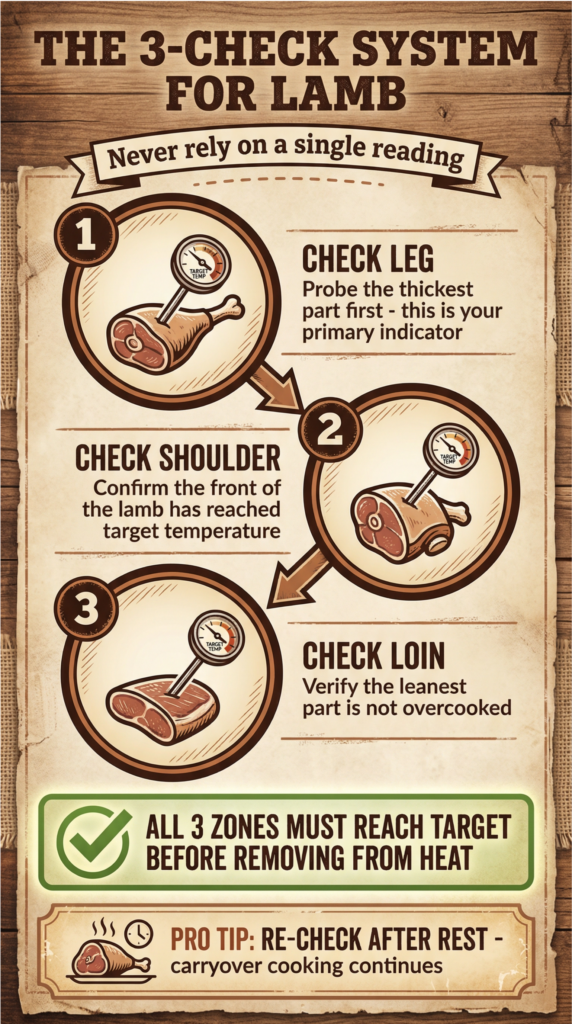
Check 3 zones before you call it done
Before you even think about removing the lamb from the heat, confirm your target
temperature in all three primary zones: the leg, the shoulder, and the loin. If any one
of them is below your target, the lamb needs more time.
Re-check after a brief rest (carryover cooking)
After you remove the lamb from the rotisserie, its internal temperature will continue
to rise for a short period—a process called carryover cooking. After a brief rest, it’s
wise to re-check the temperature to ensure it has remained at or above the safe
baseline.
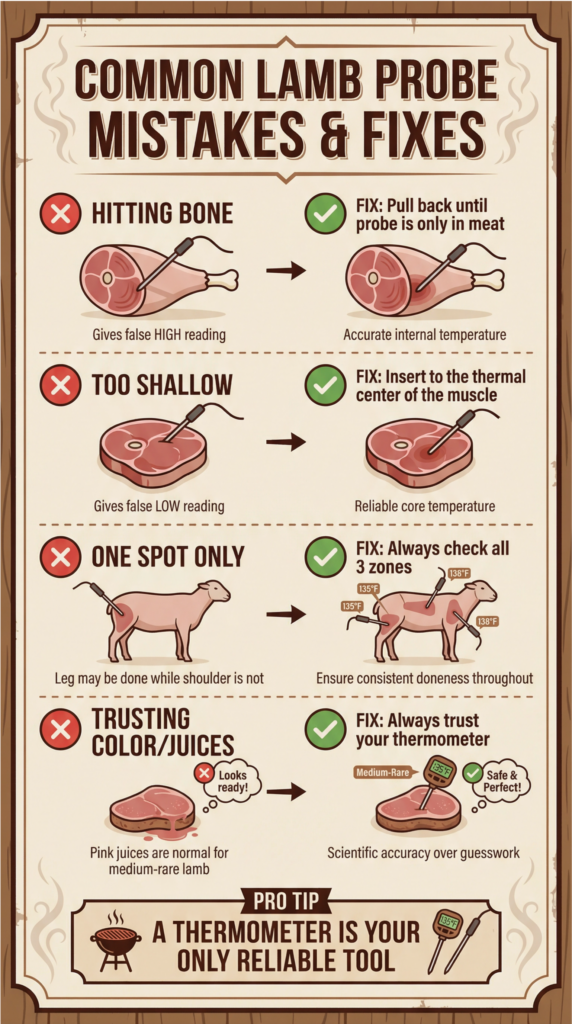
Common Probe Mistakes (And Fixes)
• Hitting Bone: This gives a false high reading. Fix: Pull the probe back until
it’s only in meat.
• Probing Too Close to the Surface: This gives a false low reading, as the
surface is cooler. Fix: Ensure the probe is in the thermal center of the muscle.
• Only Checking One Spot: The leg might be 145°F, but the loin could be
160°F. Fix: Always use the 3-check system.
• Trusting Color/Juices Over the Thermometer: Pink juices are normal for
medium-rare lamb, but they are not a reliable indicator of temperature. Fix:
Always trust your thermometer.
Quick Reference Table
Probe location cheat sheet
FAQs (Short Answers)
Where should I probe first on a whole lamb?
Always start with the leg. It’s the thickest, slowest-cooking part and your most
reliable guide.
How many spots do I need to check?
At a minimum, check the three primary zones: leg, shoulder, and loin. Checking
more spots within those zones is even better.
Can I rely on color instead of a thermometer?
No. The color of the meat and juices can be misleading. Only a thermometer can
confirm the internal temperature.
What if the loin is done but the leg isn’t?
This is normal. The loin always finishes first. You must continue cooking until the leg
reaches its target temperature. You can shield the loin with a layer of foil to prevent it
from drying out while the leg catches up.
Next Step
Complete spit roasting guide
Doneness guide
[Link: How to Tell When Lamb Is Done]
Safety checklist
[Link: Safety checklist]
Sources
[1] Health Canada. (2024). Safe cooking temperatures.
[2] USDA Food Safety and Inspection Service.
[3] R-Grill.