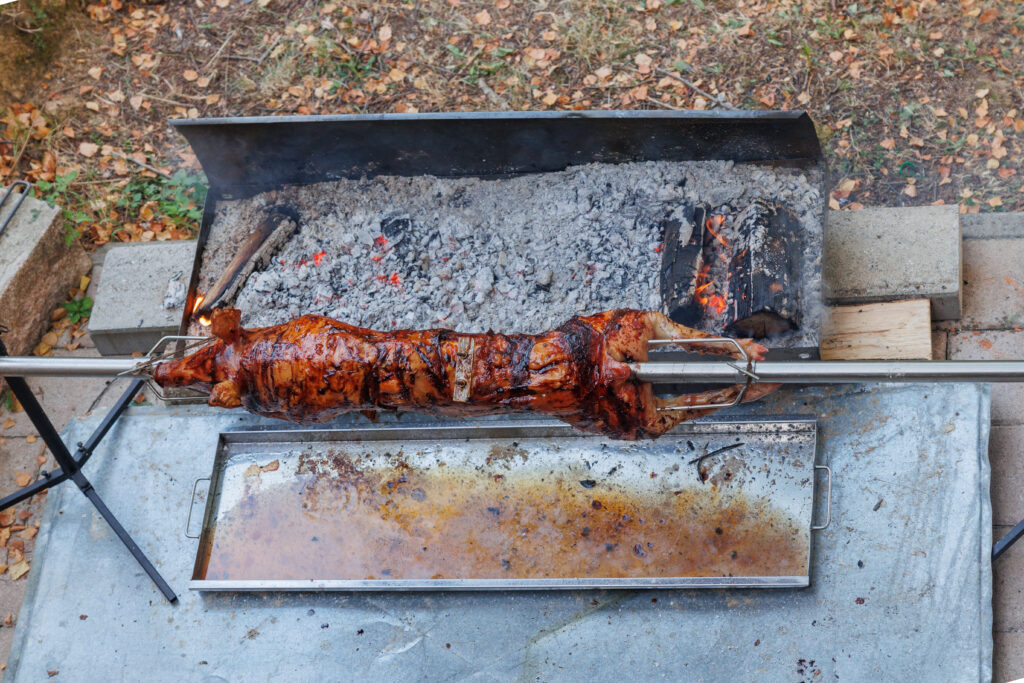
Quick Answer: The Goal of Heat Control The main goal is to create steady,
radiant heat from a stable coal bed, not direct, licking flames. The biggest
mistakes are getting the fire too hot too early, having an uneven distance
between the meat and the coals, and not having a plan for wind. Successful heat
control is about having an adjustment mindset: make small moves, wait for them
to take effect, and re-check. For a complete setup guide, see our Link: How to
set up a spit roast.
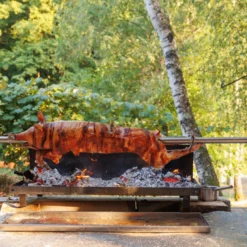
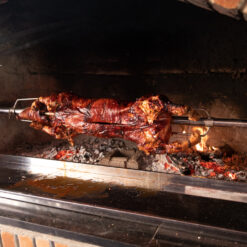
Successful spit roasting relies on mastering one core concept: you are cooking with
radiant heat, not direct flames. Think of your coal bed as a radiator, not a blowtorch.
The consistent, glowing energy it releases is what cooks the meat evenly. Direct
flames, on the other hand, are unpredictable and lead to a charred exterior and an
undercooked interior.
Why direct flames are the enemy (most of the time)
Direct flames cause flare-ups and scorching. A flare-up is a burst of intense flame
caused by fat or oil dripping from the meat onto hot coals, creating a grease fire [1].
These flare-ups can quickly burn your food, especially anything with a sugar-based
sauce or a delicate spice rub, which will go from charred to burnt in seconds [1]. The
goal is to manage the fat drippings and the fire so that flames never have a chance
to lick the meat.
What “steady heat” looks like in real life
Steady heat isn’t complicated. You can see it in the results. Look for these simple
cues:
• Even Browning: The surface of the meat should develop a consistent, deep
mahogany color over time, not dark spots in the first hour.
• Steady Drip: You should see a regular drip of fat rendering from the meat. If
the dripping is frantic and causing constant flare-ups, your fire is too hot or too
direct.
• Stable Coals: The coal bed should be a uniform field of glowing embers,
often covered in a layer of white ash. There should be no large, open flames
shooting up.
Creating zones is about arranging your coals. Instead of a flat, even layer, you bank
them to create different heat intensities.
• Banked Coals (Two-Zone): This is the most common and useful setup. Pile
the majority of your hot coals along the back of the firebox, with a much
thinner layer or no coals at all in the front. This creates a hot “radiant wall” at
the back and a cooler safety zone at the front.
• Split Fire (Three-Zone): Pile coals in two separate banks on opposite ends of
the firebox, leaving an empty, cool zone in the middle. This is excellent for
cooking larger cuts like a whole pork loin, as it provides even heat from both
sides [2].
Consistent distance from the heat source is critical for even cooking. A few inches
can be the difference between perfectly rendered skin and a burnt, rubbery mess.
What happens when you’re too close
If the meat is too close to the coals, the outside will cook far too quickly. You’ll see
fast, dark browning, the skin may dry out and crack, and constant flare-ups will occur
as the fat renders and immediately ignites. The result is a pig or lamb with a burnt
exterior while the deep tissue near the bone is still undercooked.
What happens when you’re too far
If the meat is too far from the coals, the cooking process will be painfully slow. The
skin may become tough and rubbery instead of crisp because the heat isn’t intense
enough to render the fat properly. You will struggle to reach your target internal
temperature and waste a lot of fuel in the process.
Keeping distance consistent across the whole animal
It’s crucial that the spit is perfectly level and the animal is balanced. If one side of the
spit is lower than the other, or if one part of the animal hangs closer to the fire, that
area will cook much faster. Check that the distance from the coals to the shoulder is
the same as the distance from the coals to the hams.
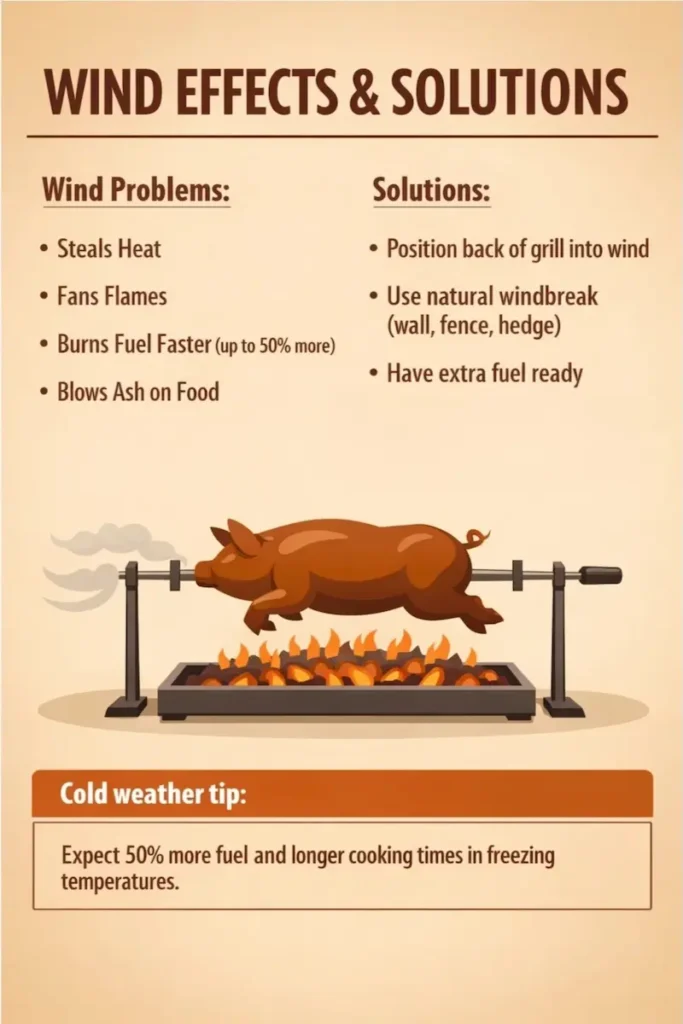
Wind is the number one enemy of a stable fire. It can steal heat, cause temperature
swings, and dramatically increase your fuel consumption.
How wind changes heat and fuel use
Wind acts like a bellows, fanning the flames and making your fire burn hotter and
faster than you intended. A strong gust can blow through your vents and cause a
sudden temperature spike [3]. Conversely, wind also steals radiant heat from the
surface of the meat and the grill itself, forcing your fire to work harder and burn
through more fuel just to maintain temperature [4]. This can increase your fuel
consumption by up to 50% in cold, windy conditions [5].
Windbreaks and simple layout
Always try to position your grill with its back to the wind. This minimizes the amount
of air that can rush through the vents. If possible, set up near a natural windbreak
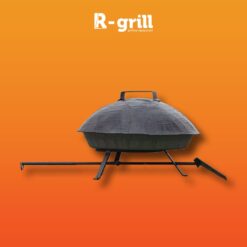
like a wall or a hedge, but maintain a safe distance to prevent a fire hazard. R-Grill
offers a purpose-built Firepit with Windshield for exactly this reason, providing a
secure and stable environment for your fire.
Cold weather: why your first hour may feel “wasted”
Grilling in temperatures below freezing will significantly extend your cooking time [6].
The cold air constantly pulls heat away from the metal of the grill and the surface of
the meat. Don’t be surprised if it takes much longer for the grill to come to
temperature and for the meat to start browning. This is normal. You will need more
fuel and more time. For baseline estimates, see our time-by-weight guides:
Time by Weight: Pig and Time by Weight: Lamb.
Flare-ups are sudden, intense flames that can scorch your food. They are almost
always caused by fat dripping directly onto hot coals.
The main causes
• Fat Drippings: This is the primary cause. As the meat cooks, fat renders,
drips down, and ignites.
• Too Much Direct Flame: If your fire is already producing large flames,
dripping fat will only make it worse.
• Dirty Fire: A fire with a lot of unburnt wood or debris can contribute to flare-
ups.
Immediate response steps
1. Don’t Panic: Stay calm.
2. Move the Meat: If using a two-zone fire, immediately move the meat over the
cool zone.
3. Cover the Grill: If you can’t move the meat, quickly cover the grill. This cuts
off the oxygen supply and will extinguish the flare-up [1].
4. NEVER Use Water: Do not spray water on a grease fire. It will spread the
burning grease and throw ash all over your meat [1].
Prevention: drip management and fire discipline
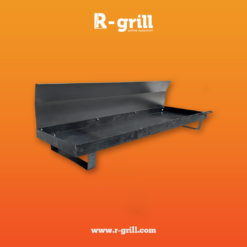
The best way to manage flare-ups is to prevent them. Using a two-zone fire with a
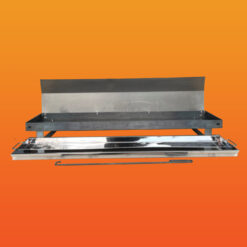
drip pan in the cool zone is the most effective method. A stainless steel tray placed
under the front half of the animal will catch the majority of the drippings, preventing
them from ever hitting the coals.
Good heat management is a feedback loop. You make a change, you wait to see its
effect, and then you decide on the next move. Don’t chase the temperature by
making constant, large adjustments.
The 15-minute rule
After you make an adjustment—like adding fuel or changing the spit height—wait at
least 15 minutes before making another change. It takes time for the system to
stabilize and for the effect of your change to become clear. Over-adjusting is a
common mistake that leads to frustrating temperature swings.
What to log every hour
Keeping a simple mental or written log can be helpful. Every hour, quickly check:
• Fuel: Does the coal bed need replenishing?
• Position: Is the meat in the right heat zone?
• Browning: Is the color developing evenly?
• Internal Temp: Are you on track toward your target temperature?
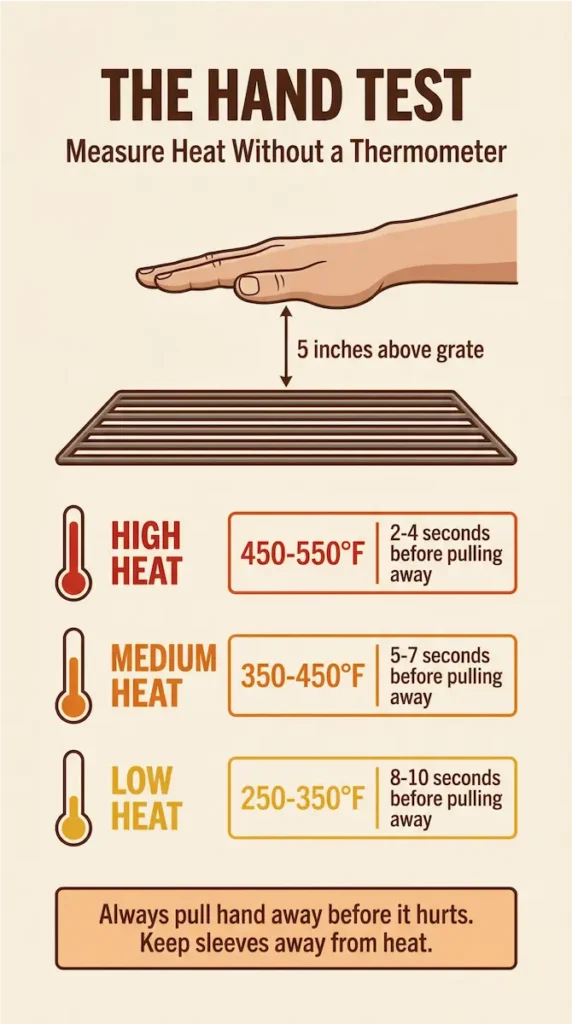
How far should the pig/lamb be from the fire?
There is no single magic number, as it depends on the intensity of your fire. A good
starting point is where you can hold your hand at the level of the meat for 5-7
seconds before it becomes uncomfortable (a medium heat) [7]. Adjust from there
based on how the skin is browning.
Should flames ever touch the meat?
No. You are cooking with the radiant heat from the coals, not the flames themselves.
Flames will scorch the meat.
How do I stop flare-ups fast?
The fastest way is to move the meat away from the fire into a cool zone. If you can’t,
close the lid of your grill to cut off oxygen.
What’s the best way to handle wind?
Position the back of your grill into the wind and create a physical windbreak if
possible. Be prepared to add fuel more frequently.
Do I need different heat control for lamb vs pig?
Yes. Lamb is leaner and generally smaller, so it cooks faster and is more sensitive to
drying out. It often requires slightly lower or more distant heat than a pig of a similar
size. A pig has a large fat cap that provides more protection and self-basting.
Time by Weight charts
Time by Weight: Pig
Time by Weight: Lamb
Safety checklist
[1] Serious Eats. How to Control Grilling Flare-Ups.
[2] Weber Grills. Fire Configurations.
[3] Napoleon. Heat Management | Cooking with Charcoal.
[4] Kick Ash Basket. How to Grill on a Windy Day.
[5] Camp Chef. How to Grill When It’s Freaking Cold Outside.
[6] Weber Grills. How to Grill in the Winter.
[7] Weber Grills. Measuring Heat: The Hand Test.
[8] R-Grill