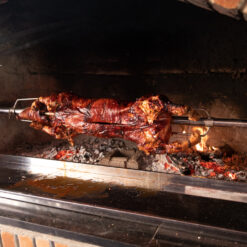
Roasting a whole pig on a spit is an impressive and rewarding way to feed a crowd, creating a memorable centerpiece for any gathering. While it may seem daunting, with the right equipment and a clear plan, anyone can achieve a perfectly cooked hog with juicy, tender meat and crispy skin. This guide provides a complete, step-by-step approach to ensure your spit roast is a resounding success.
How to Spit Roast a Whole Pig For a beginner, a pig in the 50- 80 lb (23-36 kg) range is a manageable start. As a rule of thumb, expect a minimum cooking time of about one hour for every 10-12 pounds of pig, but always plan for more.
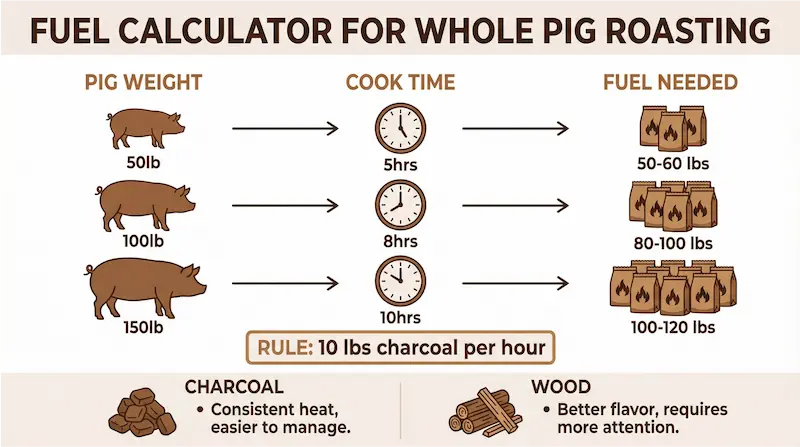
The first hour often just warms the pig and builds the coal bed, especially in cold weather. You will need more fuel than you think – an open spit loses a lot of heat, so have at least 80-100 lbs (36-45 kg) of charcoal or an equivalent amount of hardwood ready.
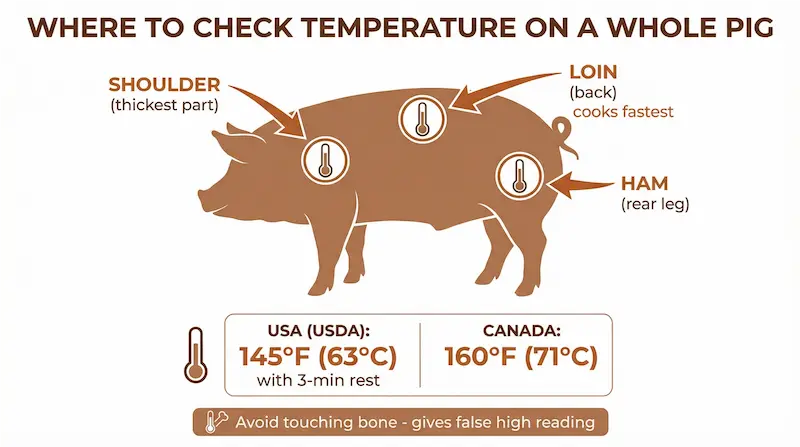
The pig is safely cooked when the thickest parts (shoulder and ham) reach an internal temperature of 145°F (63°C) in the US [1] or 160°F (71°C) in Canada [2].
The biggest mistakes to avoid are starting with the heat too high, placing the pig an uneven distance from the fire, and not using a meat thermometer to check for doneness in multiple spots.
Spit roasting is a historic cooking method where meat is skewered on a long, solid rod, the spit and rotated over a fire.
The constant rotation ensures the meat cooks evenly and self-bastes in its own juices, resulting in exceptionally moist and flavorful results that are difficult to achieve with other methods.
A spit rotisserie is the modern mechanical evolution of this ancient technique. It consists of the spit, a motor to automate the rotation, and a frame to hold the meat over the heat source.
This setup allows for consistent, hands-free cooking, which is essential for large cuts of meat like a whole hog that require many hours to cook.
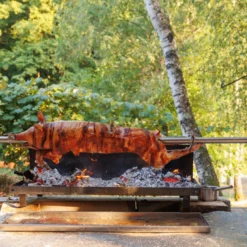
For a whole hog, the spit rotisserie method is unparalleled. The slow, steady rotation allows the layers of fat to render and baste the meat continuously, preventing it from drying out over the long cooking time.
This process creates a succulent, tender interior while the exterior skin becomes perfectly crisp. It’s a method that produces both a spectacular visual and delicious results for a large group.
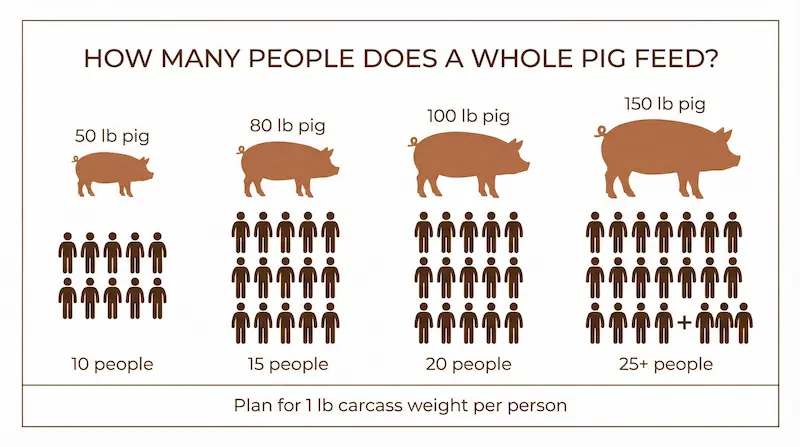
The ideal pig size depends on the number of guests you plan to serve and the capacity of your equipment. A good rule of thumb for servings is to plan for about one pound of carcass weight per person.
For those new to spit roasting, a pig in the 50 to 80-pound (23-36 kg) range is recommended. This size is more manageable to handle, secure, and balance on the spit.
It also has a shorter and more predictable cooking time, reducing the chances of error while you learn the process.
Larger pigs require significantly more time to cook. The heat must penetrate deep into the thickest parts of the animal, which demands patience and careful heat management.
While not a linear relationship, adding more weight will always add more hours to the cook.
Proper preparation is crucial for a successful roast. The goal is to ensure the animal is clean, seasoned, and securely mounted for even cooking. While detailed recipes for brines and rubs are widely available, the fundamental steps are straightforward.
• Clean and Dry: Ensure the cavity is clean and pat the entire animal, inside and out, completely dry with paper towels. A dry surface is essential for achieving crispy skin.
• Season: At a minimum, generously salt the interior cavity and the exterior skin. This draws out moisture and helps crisp the skin.
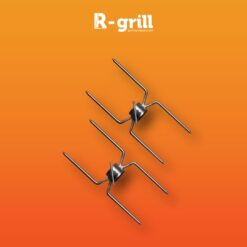
• Secure: The most critical step is to secure the animal to the spit. Use forks and wire to clamp the spine tightly to the spit rod in several places. The animal must not be able to shift or spin independently of the spit.
• Balance: An unbalanced load will strain the rotisserie motor and cause uneven cooking. Test the balance by rotating the spit by hand. If it spins freely without a heavy side consistently falling to the bottom, it is well-balanced.
• Truss: Secure the legs tightly to the spit or the body of the pig. Any loose, dangling parts are likely to burn. For detailed instructions on seasoning, brining, and advanced preparation techniques, please refer to our complete guide.
Cooking time is influenced by the pig’s weight, the type of fuel, weather conditions, and the distance from the fire. The following table provides a general guideline based on owner-provided data and external sources.
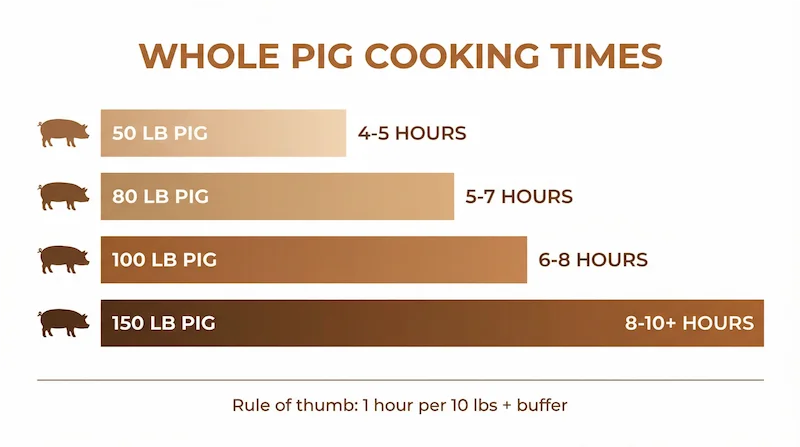
A 100-pound pig will typically require 6 to 8 hours of roasting time. It is crucial to start early and allow for a buffer. Factors like wind and cold ambient temperatures can extend the cooking time significantly.
The only reliable way to determine doneness is with a meat thermometer. Color is not a reliable indicator of safety or doneness.
• Temperature Map: Where to Probe So You Don’t Guess To ensure the pig is cooked safely and thoroughly, you must check the internal temperature in multiple locations. The thickest parts of the animal cook the slowest.
• Pig Map: Probe the shoulder (the thickest part), the ham (rear leg), and the loin. The loin will finish cooking first. Ensure the thermometer does not touch bone, as this will give a false high reading.
• Lamb Map: For a whole lamb, focus on the thickest part of the leg and the shoulder.
• Safe vs. Tender: The USDA defines pork as safe to eat at an internal temperature of 145°F (63°C), followed by a three-minute rest period [1]. Health Canada recommends a higher temperature of 160°F (71°C) [2]. While the pig is safe at these temperatures, connective tissues in the shoulder and ham break down and become more tender at higher temperatures, around 180-195°F (82-90°C).
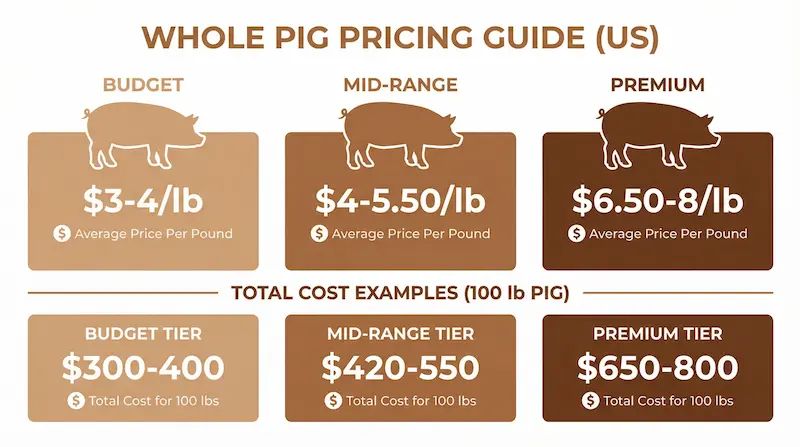
The cost of a whole pig varies widely based on size, source, and region. Prices are typically quoted per pound, either by live weight or hanging (carcass) weight.
Average price of a whole pig (US & Canada focus)
In the United States, prices can range from $3.00 to $8.00 per pound. A standard farm-raised pig for roasting typically falls in the $4.00-$5.50/lb range [3, 4]. In Canada, expect to pay between $9.00 and $12.00 per pound (CAD).
What affects the price
• Size: Smaller pigs often have a higher price per pound.
• Source: Pigs from small, local farms that use specific practices like pasture-raising will cost more than those from larger commercial operations.
• Season: Demand can increase prices around major holidays.
Running out of fuel mid-roast is a disaster. Always buy more than you think you will need.
An open spit rotisserie is not fuel-efficient and requires a continuous supply of hot embers.
Dry, seasoned hardwood is the traditional choice and imparts the best flavor. Beech, oak, hickory, and fruitwoods like apple are excellent options. However, wood requires more effort to manage and burn down into a consistent coal bed.
Charcoal, particularly lump charcoal, provides a more consistent and predictable heat source, making it a great choice for beginners. A combination of a charcoal base with wood chunks added for flavor is a popular and effective strategy.
A good rule of thumb for an open spit is to plan for 10 pounds of charcoal for every hour of cooking [5]. For a 100-pound pig, this means having at least 80-100 pounds of charcoal on hand. For wood, a 100-pound pig may require half a cord of hardwood.
Time & Fuel Calculator
• Time (Hours) ≈ Weight (lb) / 10 + Buffer: For a 90 lb pig, this would be 90 / 10 = 9 hours. Add a 1-2 hour buffer.
• Fuel Planning: For that 9-hour cook, plan for at least 90-100 lbs of charcoal. It is always better to have a bag left over than to run out.
Proper setup is key to controlling the temperature and achieving an even cook.
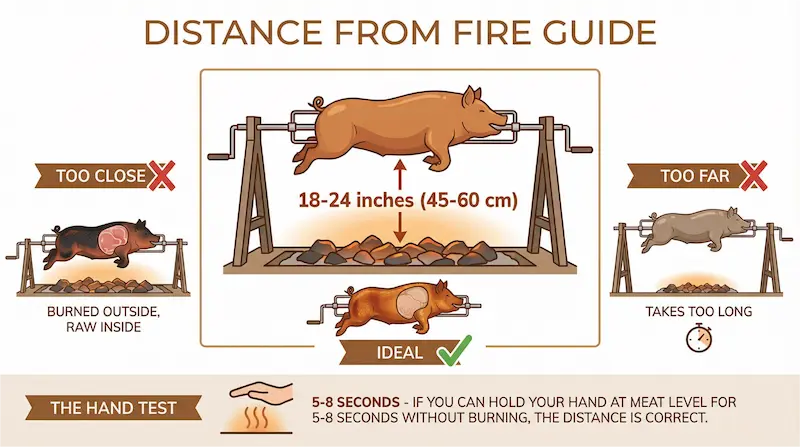
The distance between the pig and the heat source is critical. Too close, and the skin will burn before the inside is cooked. Too far, and the cooking time will be excessively long.
A good starting point is to have the pig 18 to 24 inches (45-60 cm) away from the coal bed [6]. A reliable method is the “hand test”: you should be able to hold your hand at the level of the pig for 5-8 seconds before it becomes uncomfortably hot.
Build a steady coal bed. Don’t cook over open flames. You want a mature, glowing bed of embers. Start your fire in a separate “burn barrel” or to the side of the roaster and move the hot coals into position under the pig.
This prevents ash and soot from coating the meat.
Maintain a consistent temperature by adding a few logs or a small amount of charcoal every 30-60 minutes. Dumping a large amount of fuel on at once will cause temperature spikes and dips.
Fat dripping onto hot coals will cause flare-ups that can scorch the pig. Keep a spray bottle with water handy to douse any flames. Having the fire to the sides of the pig, rather than directly underneath, can also help minimize flare-ups.
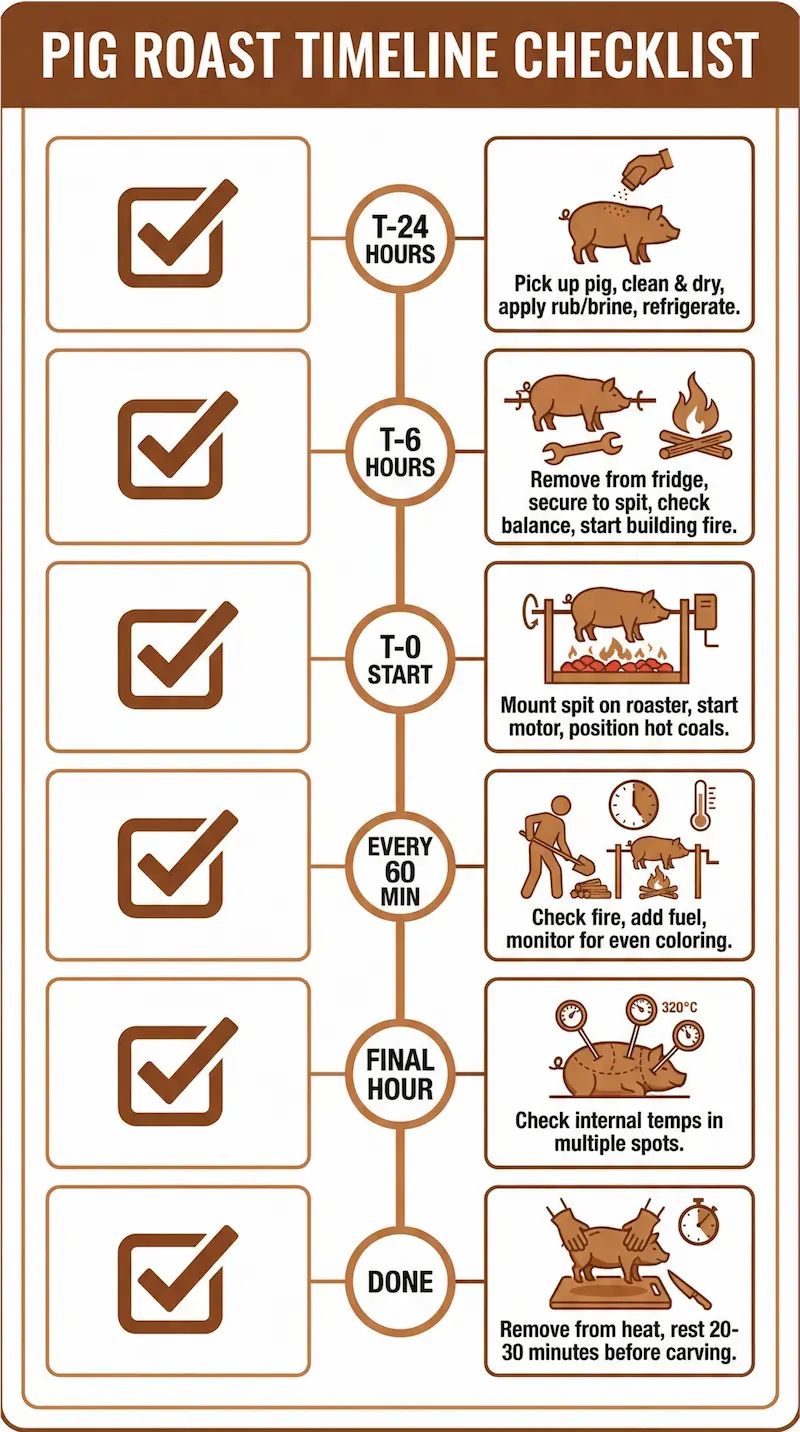
• T-24h: Pick up the pig, clean and dry it, and apply any desired brine or rub. Keep refrigerated.
• T-6h: Remove pig from refrigeration. Secure it to the spit and check the balance. Begin building your fire.
• T-0: Mount the spit on the roaster and start the motor. Position the hot coals.
• Every 30 min: Check the fire and add fuel as needed. Monitor the pig for even coloring.
• Final Hour: Begin checking internal temperatures with a meat thermometer.
• Resting: Once the target temperature is reached, remove the pig from the heat and let it rest for 20-30 minutes before carving.
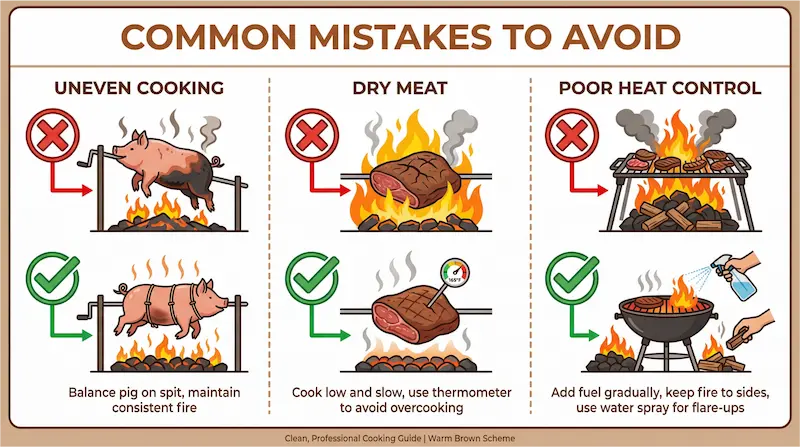
Uneven cooking
• Cause: Poorly balanced pig, inconsistent fire, or incorrect distance from the heat.
• Fix: Take time to balance the pig perfectly on the spit. Maintain a consistent coal bed and rotate the pig’s position relative to the fire if one side is cooking faster.
Dry meat
• Cause: Cooking with too high heat, or for too long.
• Fix: Cook low and slow. Use a thermometer to pull the pig off the heat as soon as it reaches the target temperature. The self-basting nature of spit-roasting helps, but it can’t save a pig cooked at scorching temperatures.
Poor heat control
• Cause: Adding too much fuel at once, or not managing flare-ups.
• Fix: Add fuel gradually. Keep the fire to the sides of the pig, not directly underneath. Use a water spray bottle to manage flare-ups.
Each method has its strengths, and the “better” choice depends on the desired outcome.
Traditional barbecue, especially in a pit or smoker, is about low-and-slow cooking with the influence of smoke. A rotisserie cooks with more direct, radiant heat. While you can get smoky flavor on a rotisserie by using wood, the primary characteristic is the self-basting process, which creates incredibly moist meat.
A smoker offers more consistent temperature control and deep smoke penetration, but it can be challenging to get crispy skin. A rotisserie excels at producing crispy skin but requires more active fire management. For a whole hog, a rotisserie provides a more dramatic presentation and a unique texture that is hard to replicate.
Having the right gear is essential for a safe and successful roast. If you want a stable, reliable setup, there are several options available.
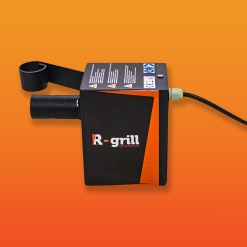
For a whole pig, a motor is not just a convenience – it’s a necessity. A whole pig is far too heavy and the cooking time too long to be turned by hand effectively. An electric motor ensures the constant, steady rotation required for even cooking.
The motor must be powerful enough to turn the weight of your pig smoothly for many hours. A weak motor will struggle and burn out. The R-Grill motors, for example, are rated to handle significant weight, with the XXL model capable of turning up to 150 lbs (68 kg) [8]. The motor’s power is typically measured in watts; the R-Grill motors are 40W, providing ample torque for large roasts [9].
If you are looking for a complete setup, here are three R-Grill options people often choose:
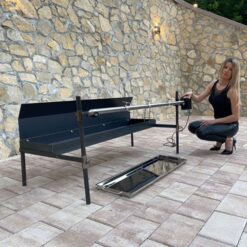
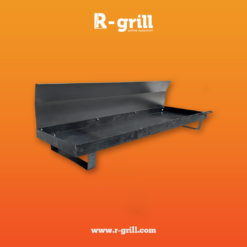
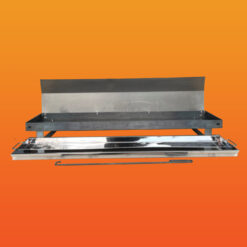
• Hog Rotisserie All-in-One Kit: This is for the person who wants everything bundled together. It includes the powerful XXL rotisserie, a firepit with a windshield, and a stainless steel tray. It’s a comprehensive solution for serious grillers [9].
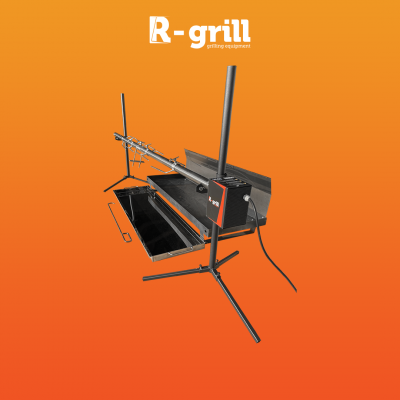
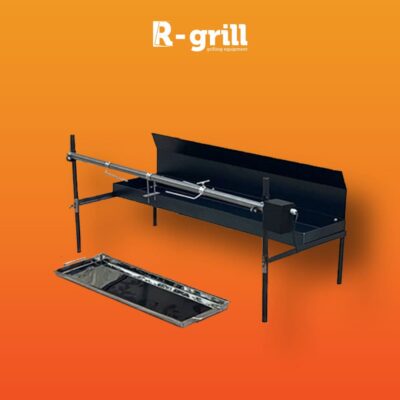
• Whole Hog Pig/Lamb Roaster Spit Rotisserie XXL Large: This is the
choice for those focusing on maximum capacity. With a 75-inch spit, it’s
designed specifically for large whole hogs up to 150 lbs [8]. (Insert photo: XXL
Rotisserie)
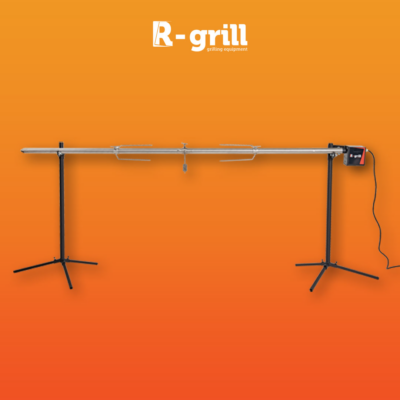
• Whole Pig/Lamb Spit Roaster Adria: This model is a great starting point for
first-timers or for those roasting smaller animals. Its 53-inch spit can handle
up to 100 lbs, making it a versatile and less intimidating option [10]. (Insert
photo: Adria Roaster)
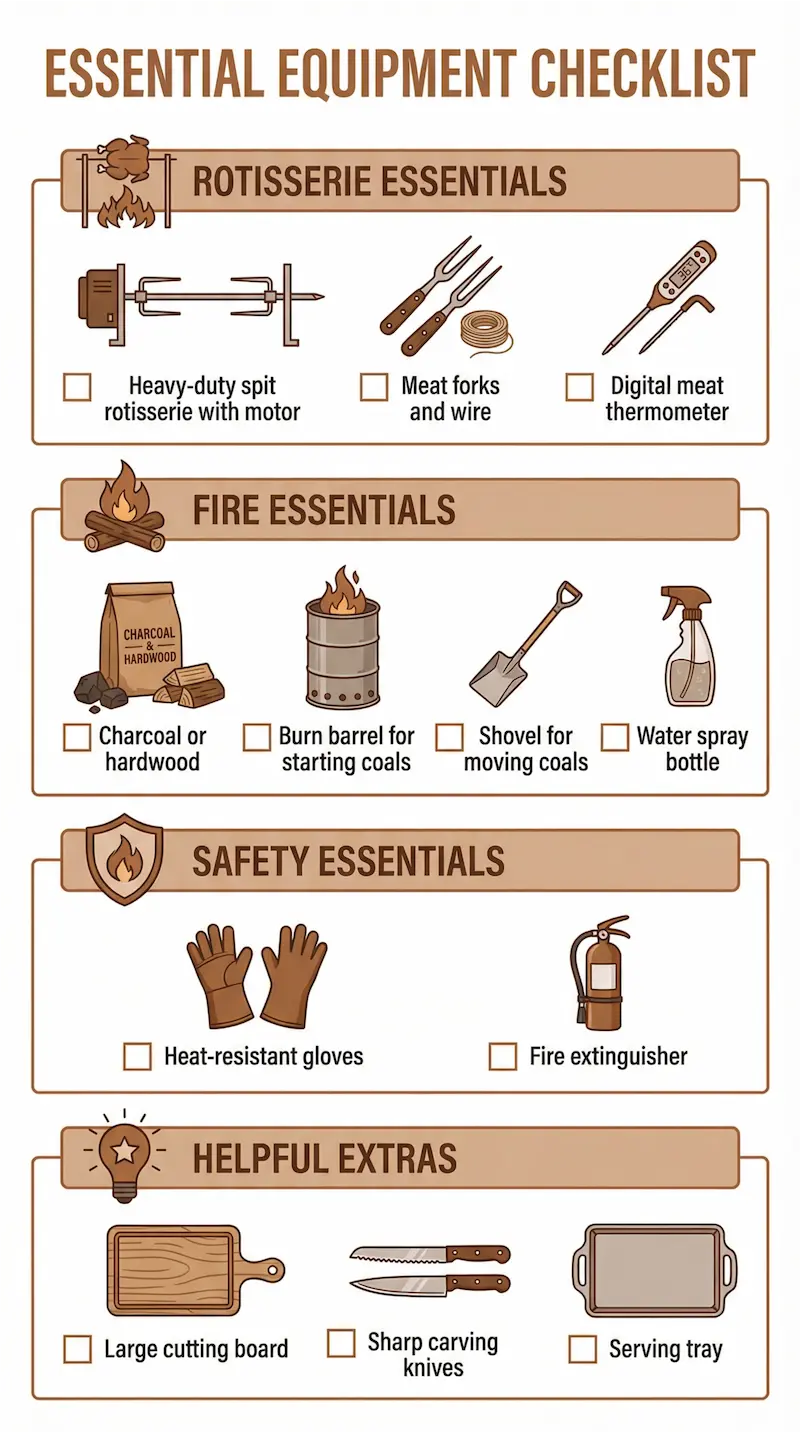
Rotisserie Essentials:
◦ Heavy-duty spit rotisserie with a powerful motor
◦ Meat forks and wire for securing the pig
◦ Digital meat thermometer
Fire Essentials:
◦ Charcoal or seasoned hardwood
◦ Burn barrel or separate area to start coals
◦ Shovel for moving coals
◦ Water spray bottle for flare-ups
Safety Essentials:
◦ Heavy-duty heat-resistant gloves
◦ Fire extinguisher
Optional Helpful Tools:
◦ Large cutting board or table for carving
◦ Sharp carving knives
◦ Large tray for serving
How many people does a whole pig feed?
Use the following table as a guide. These are conservative estimates.
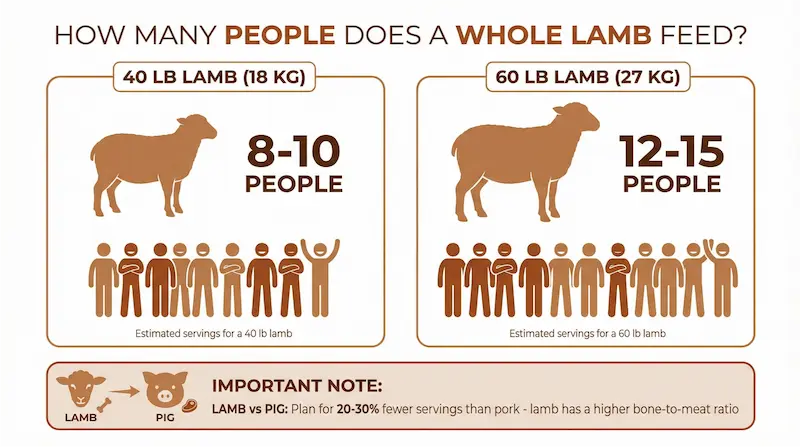
Lamb version: how many people does a whole lamb feed?
For a whole lamb of a similar weight, plan for about 20-30% fewer servings than a pig, as the bone-to-meat ratio is different.
Can beginners roast a whole pig at home?
Absolutely. The key is to start with a manageable size, use reliable equipment, and follow a clear plan. Roasting a whole pig is more about patience and process than it is about complex culinary skill.
Is spit roasting safe?
Yes, when proper precautions are taken. Always operate on a level, non-flammable surface away from structures. Never leave the roaster unattended, and keep children and pets at a safe distance.
Operating Safety:
◦ Do not use the rotisserie in rain or on wet ground.
◦ Do not touch the motor or metal parts with wet hands while operating.
◦ Always use protective, heat-resistant gloves.
◦ Ensure adequate ventilation; never roast indoors without it.
Food Safety:
◦ Keep the raw pig refrigerated below 40°F (4°C) before cooking.
◦ Cook to the correct internal temperature as verified by a meat thermometer [1, 2].
◦ Wash all surfaces, tools, and hands that come into contact with raw
meat.
[1] USDA Food Safety and Inspection Service. (2025). Safe Minimum Internal
Temperature Chart
[2] Health Canada. (2024). Safe cooking temperatures.
[3] Showalter’s Country Meats. Roasting Pigs
[4] Marview Farms. Whole Pig (For Roasting, 91-100 lbs)
[5] Dan’s Grill Rental. Roast a Pig
[6] Cove Creek Farm. (2019). The Fine Art of a Good Pig Roast
[8] R-Grill XXL 75” Pig Rotisserie For Whole Hog, Lamb & Chicken.
[9] R-Grill Hog Rotisserie All-in-One Kit
[10] R-Grill Pig Rotisserie Adria : Ultimate 53” Whole Pig Lamb Spit Roaster