Quick Answer
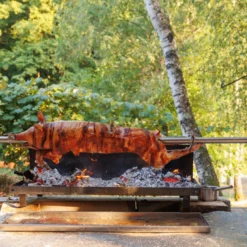
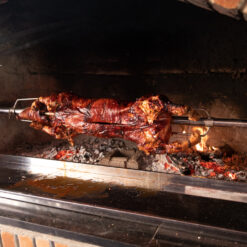
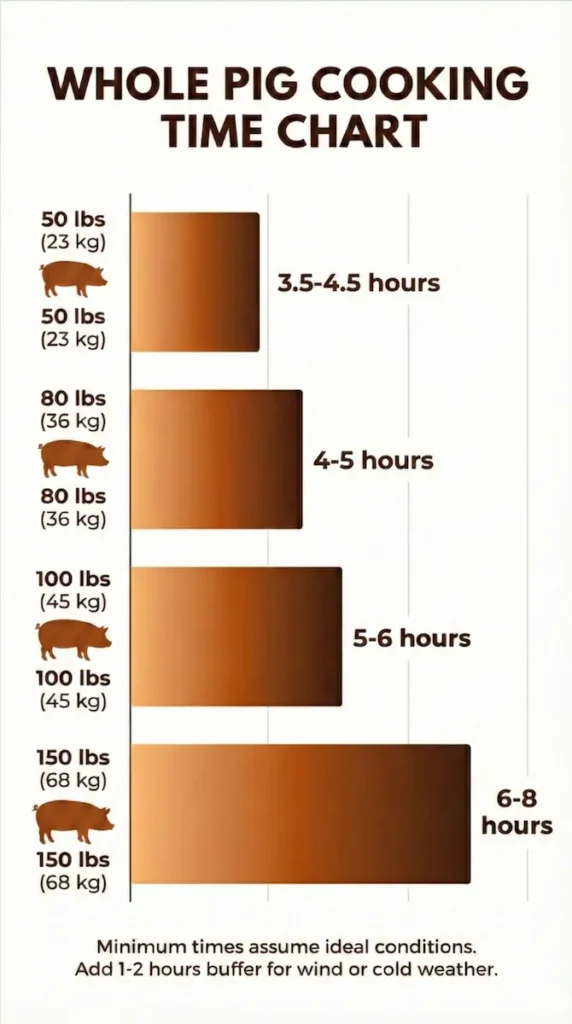
A 100-pound (45 kg) whole pig typically takes 6 to 8 hours to roast on a spit.
However, if you start with a weak fire or in cold weather, the first hour often just
warms the pig, so plan for that extra time. The real cooking starts when you have
a stable bed of hot coals.
Link: Complete Step-by-Step Guide
This chart gives you a solid starting point for planning your roast. The “Minimum”
time is the absolute shortest you should expect under ideal conditions, while the
“Typical Range” is what you should plan for in most real-world scenarios.
“First hour doesn’t count” — what that really means
Have you heard the saying that the first hour of a pig roast “doesn’t count”? There’s
a lot of truth to it. This usually happens for two main reasons:
• A Weak Fire: If you put the pig on before you have a mature bed of glowing
embers, the initial heat is too low to start the cooking process effectively.
You’re just warming the pig up.
• Cold Weather: On a cold or windy day, the environment robs a tremendous
amount of heat from your roaster. The first hour (or more) is spent just getting
the pig and the cooking chamber up to a stable temperature.
You know the “real” cooking has started when you have a consistent, stable bed of
coals and the roaster’s internal temperature is holding steady. That’s when the clock
truly begins.
While every roast is different, a simple formula can help you estimate the total time.
Time estimate formula (lb → hours)
A reliable rule of thumb is to plan for approximately 1 hour of cooking for every 14-
15 pounds of dressed pig weight. [2] For a more conservative estimate, especially if
you are new to this, using the higher end of that range is safer.
Formula: (Pig Weight in lbs / 14) = Approximate Hours
Always add a 1-2 hour buffer to your estimate to account for variables like wind,
temperature fluctuations, and the specific characteristics of your pig.
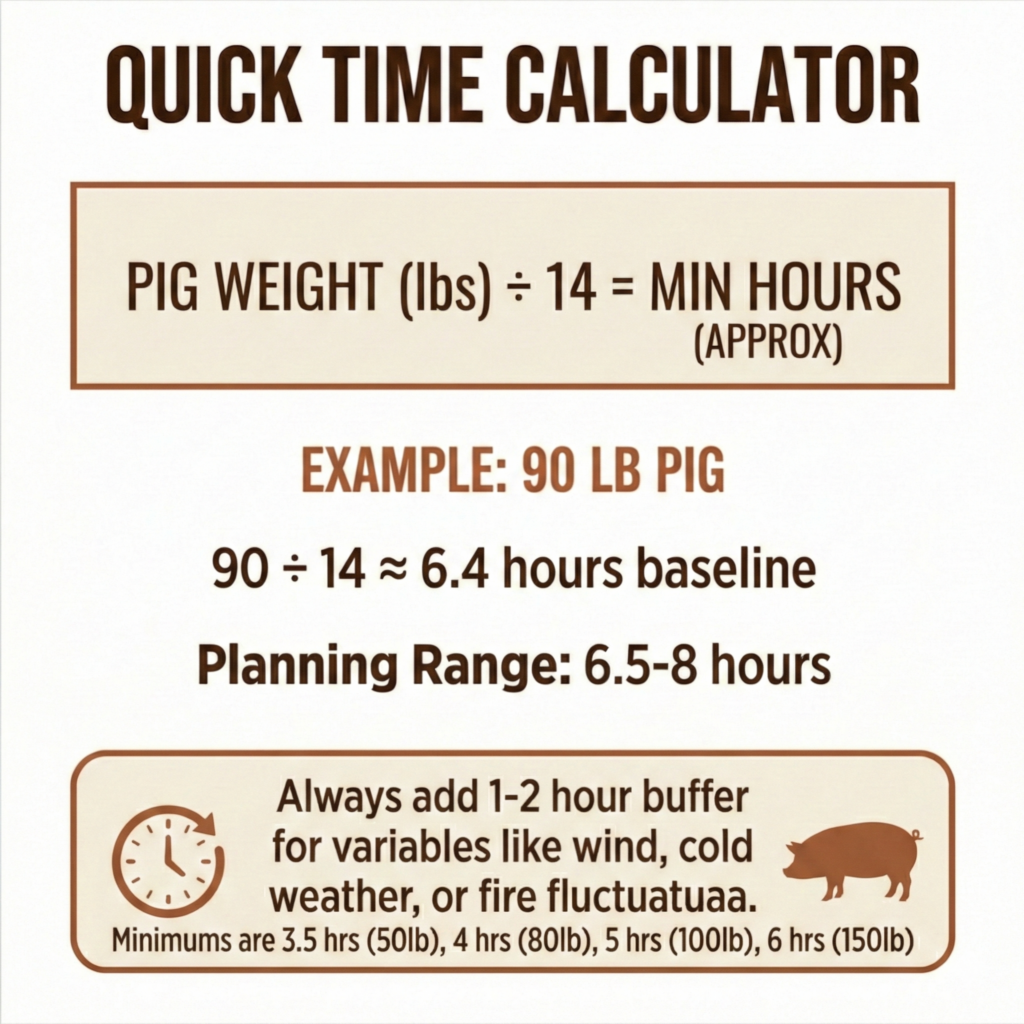
Example: 90 lb pig (worked example)
Using the formula for a 90-pound pig:
• Calculation: 90 lbs / 10 = 6,4 hours
• Estimated Range: This gives you a baseline of 6 hours. A smart planning
window would be 6 to 8 hours, giving you a buffer on either side.
When the formula fails (and why)
The formula is just an estimate. Several factors can add hours to your cook time:
• Wind and Cold: Wind is the biggest enemy of a stable temperature. It can
easily add 1-2 hours to your cook.
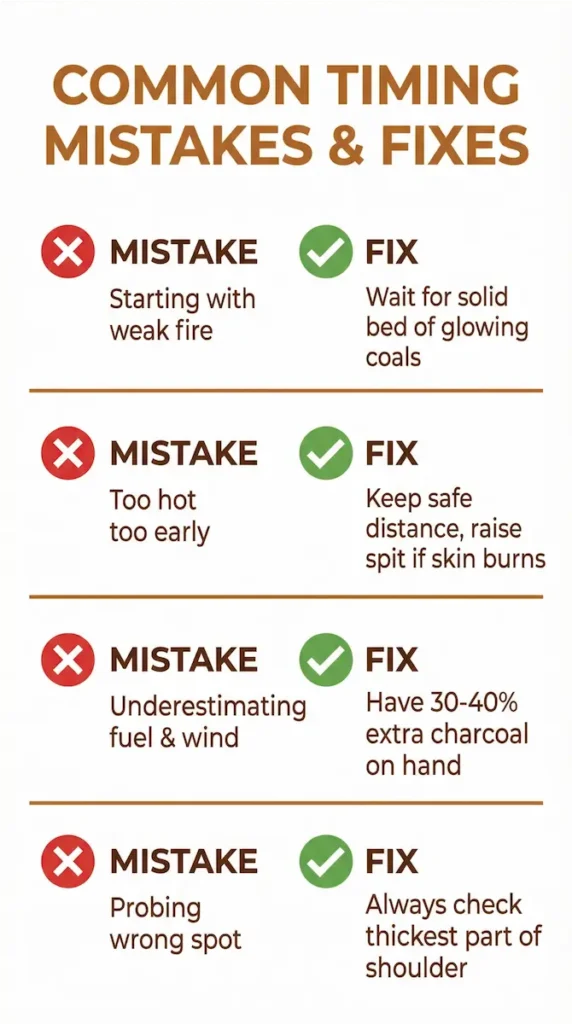
• Weak Fire: If you don’t maintain a consistent coal bed, the temperature will
drop, and the cooking will stall.
• Too Close to the Fire: It sounds counterintuitive, but placing the pig too close
can burn the skin before the inside has a chance to cook, forcing you to lower
the heat and extend the time.
• Opening the Roaster: Every time you open the lid, you lose heat and can
add 15-20 minutes to your total time.
Fire quality and coal bed stability
A deep, even bed of coals provides consistent radiant heat. If your fire is weak or
has hot and cold spots, the pig will cook unevenly. Plan on using 80-100 lbs (36-45
kg) of charcoal for a 100 lb pig roast to ensure you have enough fuel. [3] [Link: Fuel
planning guide]
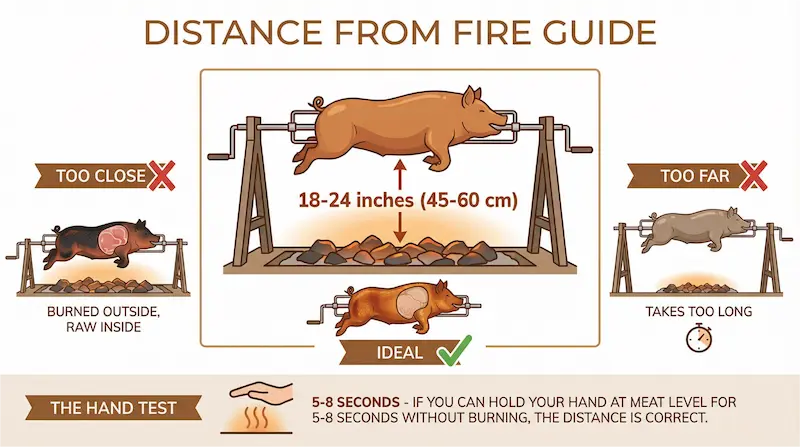
Distance from the fire and heat zones
The distance between the pig and the coals is critical. A good starting point is about
25 inches (64 cm). [4] Too close, and you risk burning the skin; too far, and you’ll be
cooking all night.
Weather (wind, cold) and why it adds hours
Wind is the number one variable that can ruin your schedule. It steals heat from the
surface of your roaster, forcing your fire to work harder and consume more fuel just
to maintain temperature. A cold ambient temperature has the same effect. On a
windy day, you may need to use up to 50% more fuel and add hours to your cook
time.
Pig size, fat, and whether it’s dressed vs live weight
It’s important to know the difference between “live weight” and “dressed weight.”
• Live Weight: The weight of the pig when it was alive.
• Dressed Weight (or Carcass Weight): The weight after the pig has been
prepared for roasting. This is typically 70-75% of the live weight. [5]
When you order a 100 lb pig, make sure you are getting a 100 lb dressed weight pig.
If you order a 100 lb live weight pig, you will end up with a much smaller carcass of
around 70-75 lbs.
Every 60 minutes: the 3 checks that matter
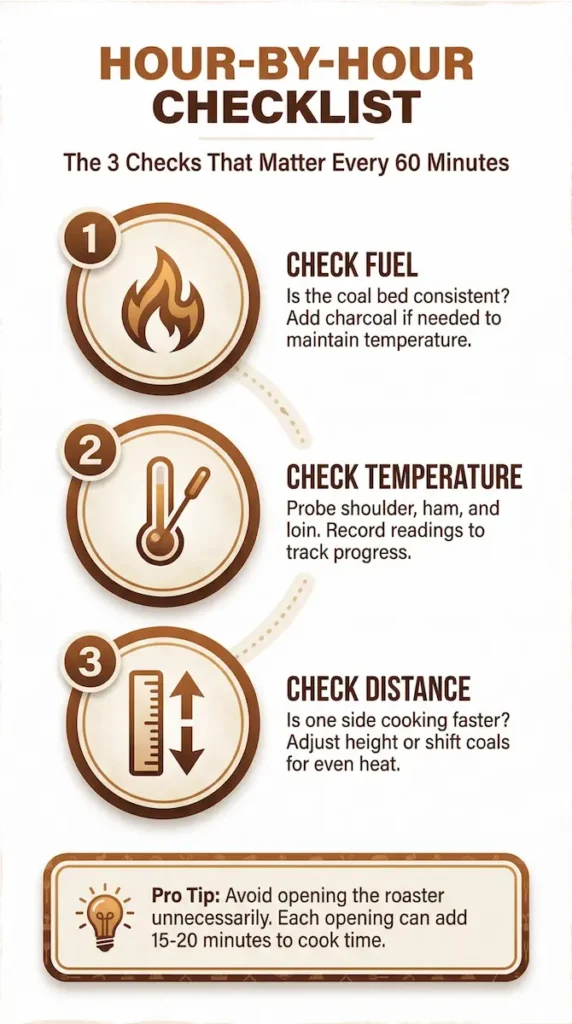
1. Fuel: Check your coal bed. Do you need to add more charcoal to maintain a
consistent temperature?
2. Temperature: Check the internal temperature of the pig in a few spots (see
our temperature map below).
3. Distance: Is the pig cooking too fast on one side? You may need to adjust the
height or shift the coals.
How to avoid “uneven cooking” early
Ensure the pig is securely balanced on the spit. An unbalanced pig will rotate
unevenly, leading to hot spots and raw spots. Our heavy-duty motors are designed
to handle large weights without struggling, but proper balance is still key to a perfect
rotation.
Finish window: when to crisp vs when to slow down
During the last hour of cooking, you may want to move the pig slightly closer to the
coals to get that perfect, crispy skin. If the pig is cooking too quickly, you can raise it
away from the heat to slow things down and let the internal temperature rise gently.
Temperature Map
For an accurate reading, you need to check the temperature in the right places.
Don’t trust just one spot!
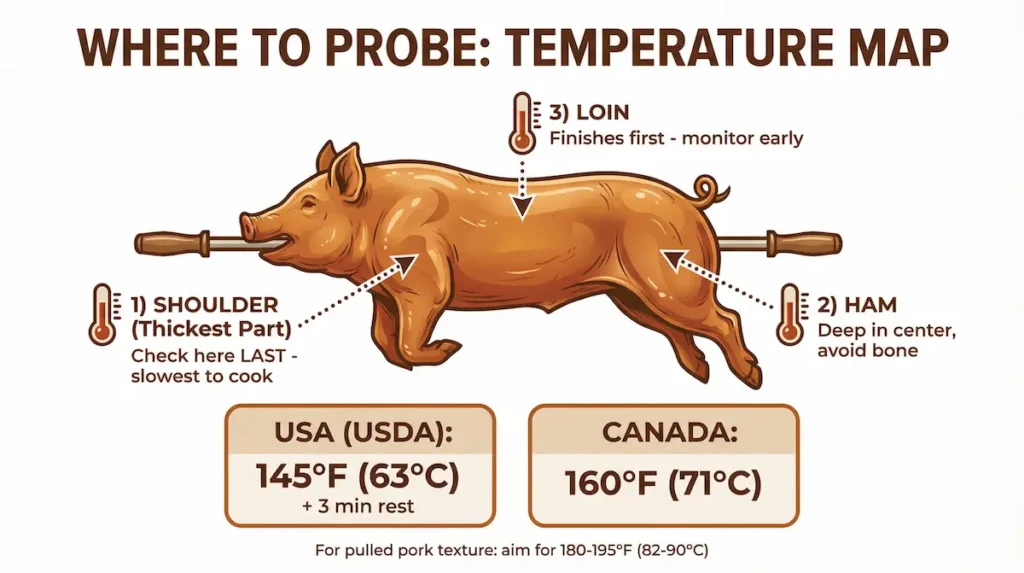
Best probe spots for a whole pig
• Shoulder (Thickest Part): This is the densest muscle and will be the last part
to finish. If the shoulder is done, the rest of the pig is done.
• Ham: The other major muscle mass. Check it deep in the center, avoiding the
bone.
• Loin: This is a leaner muscle and will finish earlier. It’s a good spot to monitor,
but don’t pull the pig until the shoulder and ham are ready.
Safe baseline vs tenderness targets (short)
According to the USDA, pork is safe to eat when it reaches an internal temperature
of 145°F (63°C), followed by a 3-minute rest. [6] However, for a whole pig roast, you
are aiming for tenderness, which requires a higher final temperature to break down
collagen in the tough shoulder and ham muscles. Most pitmasters take the pig to an
internal temperature of 180°F or higher for that classic pulled pork texture.
[Link: done article]
Thermometer-based doneness (simple rules)
A reliable meat thermometer is your best friend. Don’t guess.
• USA: The USDA guideline is a minimum internal temperature of 145°F
(63°C). [6]
• Canada: Health Canada recommends a slightly higher temperature of 160°F
(71°C). [7]
For pulled pork, you’ll want to aim for a higher final temperature, closer to 180-195°F.
Visual signs that help (but don’t replace probing)
• The skin is deep brown and crispy.
• The joints are loose, and you can easily wiggle the legs.
• The meat is visibly pulling back from the bones.
Resting time and carryover cooking (20–30 min)
Once you take the pig off the fire, it will continue to cook. The internal temperature
can rise another 5-10°F. Let the pig rest for at least 20-30 minutes before carving.
This allows the juices to redistribute, resulting in more flavorful and moist meat.
FAQs (Short Answers)
How long does a 100 lb pig take on a spit?
Plan for 6 to 8 hours, but have a buffer of 1-2 hours.
How long does a 150 lb pig take?
This is a long cook. Plan for 10 to 13 hours.
What if it’s cold outside?
Add at least 1-2 hours to your estimated time and use more fuel.
Can I speed it up by putting it closer to the fire?
No. This will burn the outside while leaving the inside undercooked. Patience is key.
Where should the thermometer go?
In the thickest part of the shoulder, without touching the bone.
Next Step
Complete step-by-step guide
Fuel planning guide
Fire distance
Temperature map (link)
Safety checklist
Sources
[1] Belson Outdoors. "Pig Roast Manual | Obtaining Your Pig
https://www.belson.com/Pig-Roast-Manual-Page-03-Instructions-Obtaining-Your-Pig
[2] Broken Arrow Ranch. "Whole Wild Boar Cooking Instructions
https://brokenarrowranch.com/blogs/recipes/whole-wild-boar-cooking-instructions
[3] Dan’s Grill Rental
[4] Michigan State University Extension
[5] University of Wisconsin-Madison Division of Extension
[6] USDA Food Safety and Inspection Service. Safe Minimum Internal Temperature Chart
[7] Government of Canada. Safe internal cooking temperatures
[8] R-Grill