Quick Answer: What to Expect The cost of a whole pig or lamb is driven by
three main factors: weight, processing level, and region. In the US, expect to
pay between $3 to $8 per pound for a whole pig, while in Canada, the range is
typically C$4 to C$7 per pound. Lamb is generally more expensive per pound.
The biggest “surprise costs” often go beyond the animal itself and include fuel,
specialized tools, and your own time. It’s also critical to know if you are paying for
live weight (the whole animal) or dressed weight (after initial processing), as
this significantly impacts the final price. For a complete overview, see our guide
on [Link: planning your roast from start to finish].
First, Define What You’re Buying (So Prices Make Sense)
When you buy a “whole animal,” the price you pay is based on a specific weight
measurement. Understanding the difference between these terms is the single most
important step to avoid confusion and surprise costs.
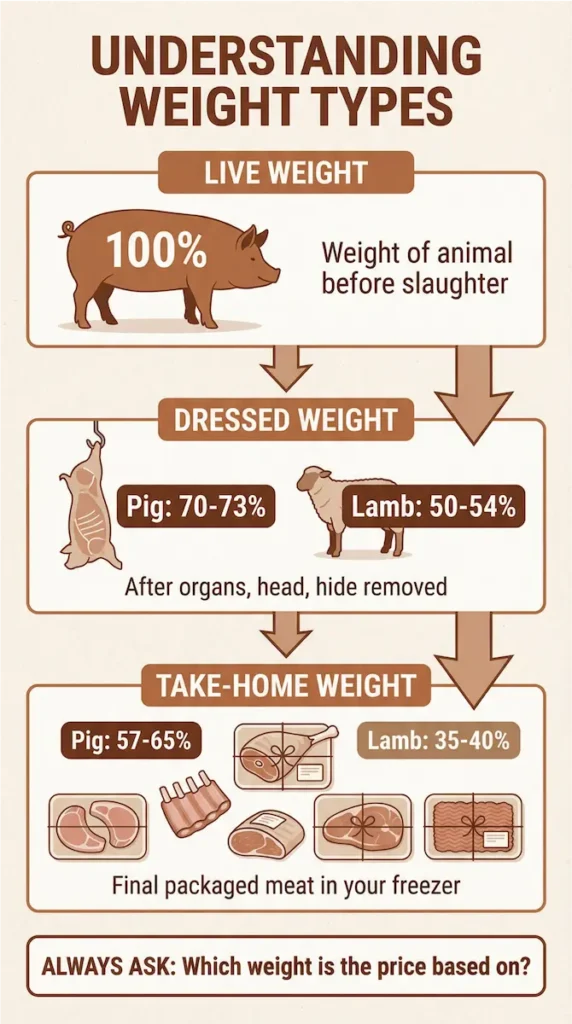
Live weight vs dressed weight vs “processed and prepped”
• Live Weight: This is the weight of the animal on the hoof, before any
processing. It’s the heaviest and least common way for consumers to buy, but
it’s the starting point for all other calculations.
• Dressed Weight (or Hanging Weight): This is the weight of the carcass after
the animal has been slaughtered, bled, and had its internal organs, head, and
hide (for lamb) or hair (for pig) removed. This is the most common weight
used for pricing by farms and butchers. A pig’s dressed weight is typically 70-
73% of its live weight, while a lamb’s is much lower, around 50-54% [1] [2].
• Processed and Prepped (or Take-Home Weight): This is the final weight of
the meat you actually put in your freezer after it has been cut, deboned, and
trimmed. This weight is always lower than the dressed weight. You can expect
to lose another 15-30% of the weight during this stage, depending on your
cutting instructions [3].
Pig vs lamb: why pricing structure differs
The main difference comes down to yield and market size. Pigs have a much higher
dressing percentage (around 70%) compared to lambs (around 50-54%) [1]. This
means a 100-pound live pig will result in a heavier carcass than a 100-pound live
lamb, spreading the base costs over more weight. Additionally, the pork industry is
larger, which can lead to more competitive pricing in some regions.
Whole Pig Price Ranges (US)
Pricing in the United States varies significantly by state, source (farm vs. butcher),
and the size of the pig.
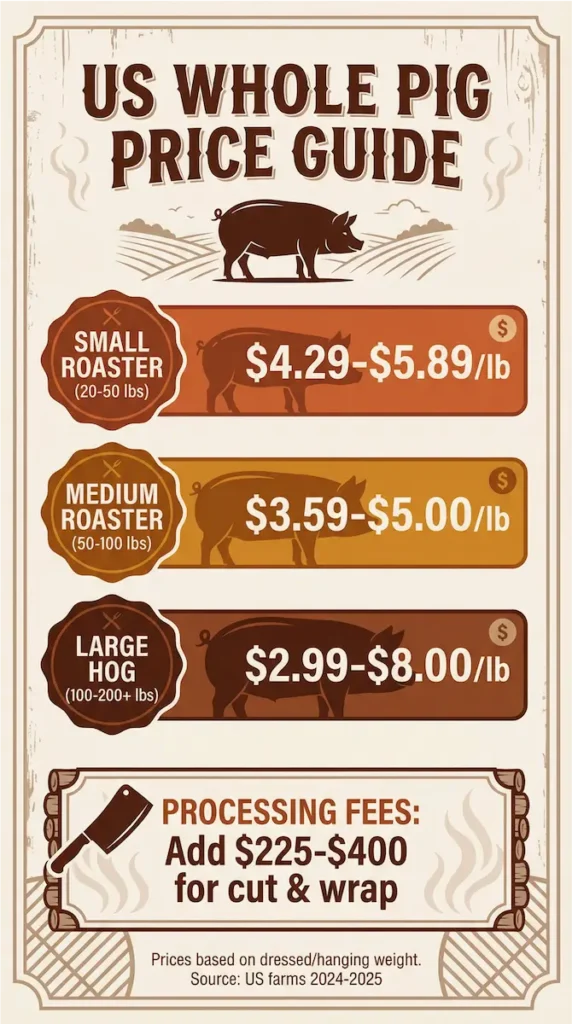
Typical $/lb or total price ranges (with citations)
Based on a survey of farms and butchers across the US, here are some typical price
ranges you can expect. Note that some prices are for dressed/hanging weight, while
others are per-pound for specific weight classes.
These prices are for the animal only and may not include processing fees.
What’s usually included (processing, skin-on, head-on/off, delivery)
Inclusions vary widely. When buying from a farm, the price is often for the hanging
weight, and you will pay for processing separately. A standard “cut and wrap” fee
can range from $225 to $400 per hog [7] [8]. When buying from a butcher shop, the
price may already include basic processing. Always confirm if the price includes:
• Slaughter and dressing
• Skin-on or skin-off
• Head-on or head-off
• Delivery or farm pickup
Whole Pig Price Ranges (Canada)
Pricing in Canada is similarly dependent on the province, with Ontario and Quebec
often having different market dynamics than the western provinces.
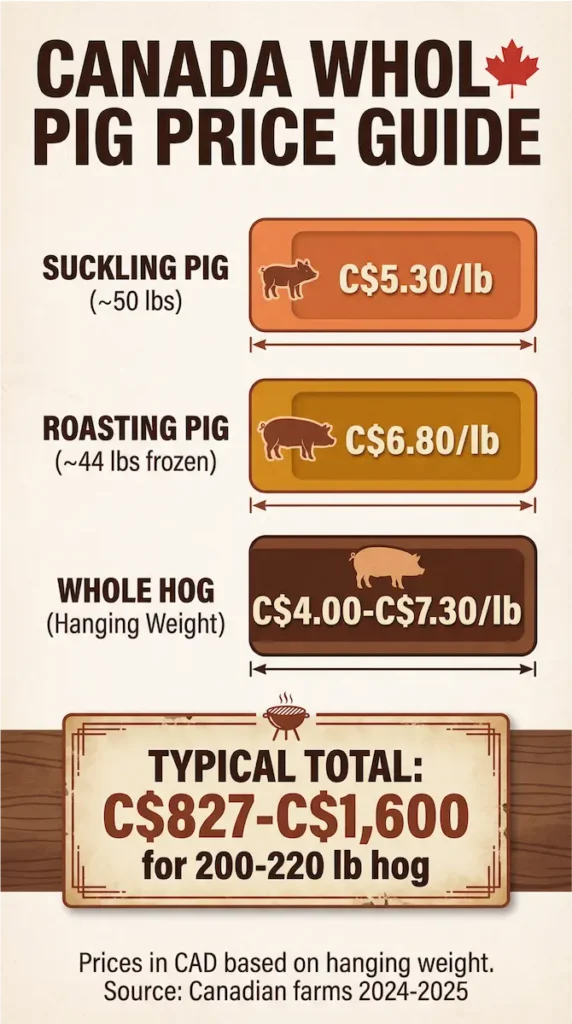
Typical C$ /lb or total price ranges (with citations)
Here are some representative prices from Canadian farms and retailers. Prices are
typically quoted in Canadian dollars per pound of hanging/dressed weight.
For a full-sized hog (around 200-220 lbs hanging weight), the total cost can range
from C$827 to C$1,600, sometimes including processing [12] [13].
Differences by province/region and availability
Availability can be more limited in certain provinces, affecting price. Ontario has a
large number of small farms offering direct-to-consumer sales, creating a competitive
market. In other regions, you may need to order further in advance from a specialty
butcher. Processing fees, if not included, can add C$1.20/lb or more to the final cost
[14].
Whole Lamb Price Ranges (US)
Lamb is generally considered a premium meat in the US, and its price reflects that. It
is almost always sold by the pound of hanging weight.
Typical $/lb or total price ranges (with citations)
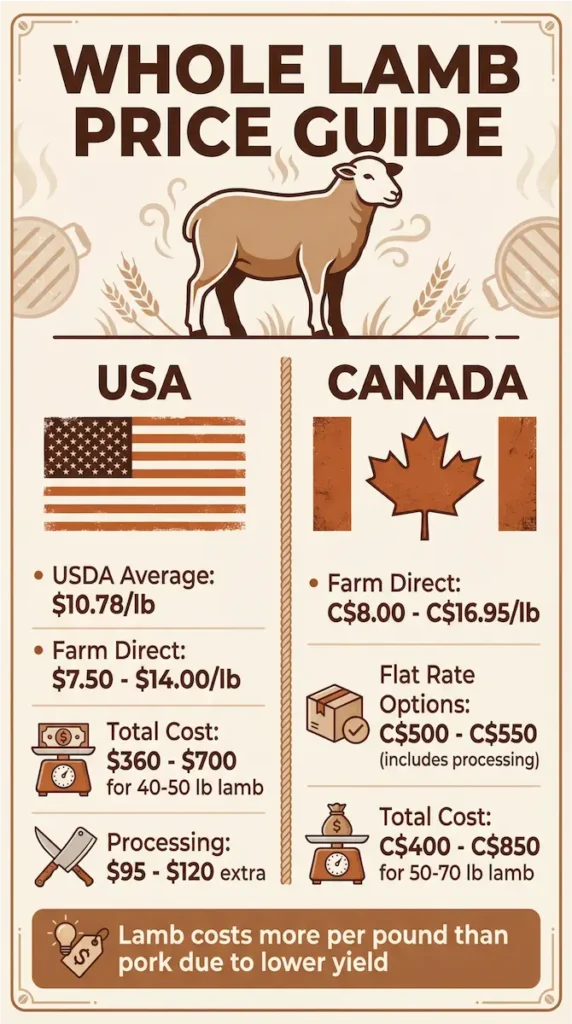
According to the USDA, the average wholesale price for a whole, grass-fed lamb
carcass was $10.78/lb in late 2025 [15]. Farm-direct prices typically range from
$7.50 to $14.00 per pound of hanging weight [16] [17].
A typical whole lamb with a hanging weight of 40-50 pounds will have a final cost
between $360 and $700 before processing [18] [17].
What’s usually included (processing, cut style, delivery)
Similar to pork, the base price often does not include processing. A separate butcher
fee for a standard cut and wrap can be around $95 to $120 per lamb [19] [20].
Some farms offer an all-in price that includes processing, which can simplify
budgeting.
Whole Lamb Price Ranges (Canada)
Canadian lamb prices are comparable to those in the US, with regional farms being
the primary source for whole-animal purchases.
Typical C$ /lb or total price ranges (with citations)
Prices for whole lamb in Canada generally fall between C$8.00 and C$17.00 per
pound of hanging weight.
Some farms offer a flat rate for a whole lamb, such as C$500 or C$550, which often
includes processing and local delivery, providing excellent value [25] [26].
Differences by province/region and seasonality
Ontario and Alberta are major lamb-producing provinces, but local farms across
Canada offer whole lamb. Prices can be higher in the spring when demand for
Easter lamb is high. Ordering in the fall, after lambs have spent a season on pasture,
can sometimes offer better value.
What Affects Price (Checklist)
What Drives the Final Cost?
• ☑Weight Yield: You pay based on weight, but your final yield of edible
meat is much lower. Higher-yield animals offer better value.
• ☑Source: Buying directly from a farm is often cheaper than from a specialty
retail butcher, but may require more coordination.
• ☑Processing Level: A simple dressed carcass is cheapest. Butterflying,
deboning, seasoning, and sausage-making all add cost.
• ☑Seasonality: Demand spikes around major holidays (Easter, Christmas)
and in the summer BBQ season, which can increase prices.
• ☑Region & Logistics: Prices are higher in areas with fewer local farms.
Delivery fees for cold-chain transport can also add up.
Total Event Cost Snapshot (Budget Table)
Remember, the animal is just one part of the total cost. Here is a sample budget to
help you plan for the entire event. Use this as a checklist and fill in the estimates for
your specific situation.
A simple budget table for a whole-hog/whole-lamb event
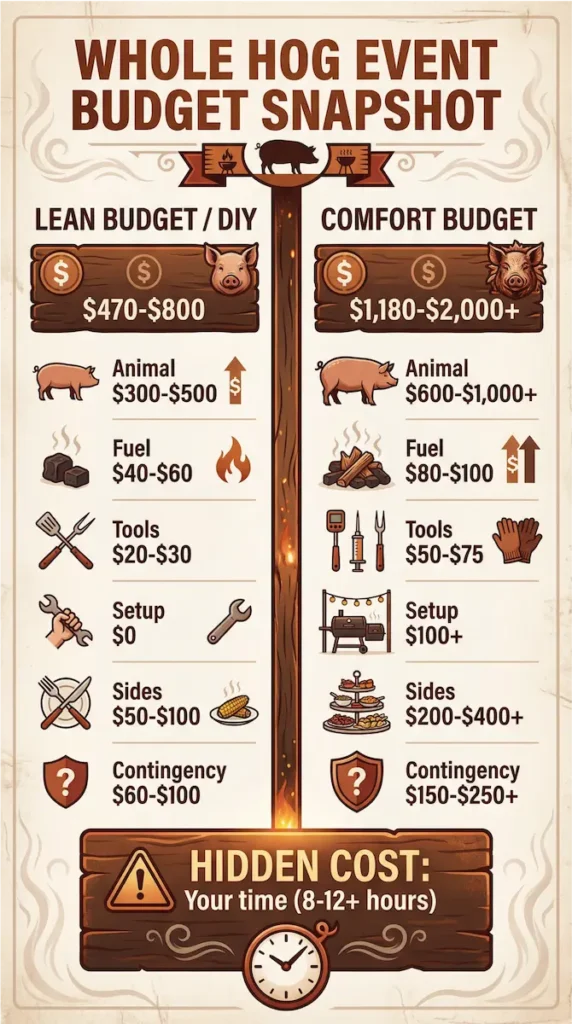
Two planning scenarios
• “Lean budget / DIY”: This approach focuses on the essentials. You buy a
smaller animal directly from a farm, handle all the prep yourself, make your
own sides, and use basic supplies. The biggest investment is your own time
and effort.
• “Comfort budget / stress-free”: In this scenario, you might buy a pre-
prepped animal from a high-end butcher, purchase pre-made sides, invest in
high-quality tools, and have more than enough fuel. This reduces stress and
the chance of last-minute problems.
How to Buy Smarter (Without Compromising Quality)
Getting the best value isn’t about finding the cheapest option, but the right one for
your needs.
Questions to ask your butcher/farm before you order
1 What weight is your price based on? (Live, dressed, or take-home?)
2 What does your processing include? (Dressing, cleaning, head/feet off?)
3 Can you prep it for a rotisserie? (e.g., butterflying the back)
4 Is the animal fresh or frozen?
5 What is your required lead time for an order?
6 Do you deliver, or do I need to arrange pickup?
When to order and how to avoid last-minute price spikes
Order well in advance—at least 2 to 4 weeks before your event, especially during
peak seasons like summer and major holidays [7]. Prices are most stable outside of
these peak times. Booking your animal in the off-season (like late fall or early spring)
can sometimes lead to better pricing and availability.
FAQs (Short Answers)
Is it cheaper to buy from a farm or a butcher?
It is often cheaper to buy directly from a farm, but you will likely have to coordinate
separately with a butcher for processing. A butcher shop offers a one-stop-shop
convenience that can be worth the extra cost.
How much pig/lamb do I need for X people? (link out)
For a detailed breakdown of serving sizes, see our guides on [Link: Time by Weight:
Pig] and [Link: Time by Weight: Lamb]. A general rule is about 1-1.5 pounds of live
weight per person for a pig.
Does frozen cost less than fresh?
Sometimes, but not always. Frozen animals are easier to store and transport, which
can reduce costs for the seller. However, a premium, flash-frozen product may cost
the same as fresh. Always ask.
What costs more: pig or lamb?
Lamb almost always costs more per pound than pork due to its lower yield and
smaller market size.
What’s the biggest hidden cost?
Time. A whole animal roast is an all-day event requiring constant attention. The
second biggest hidden cost is fuel—most people underestimate how much charcoal
or wood they will need, especially on a windy day.
Next Step (Internal Links)
Planning your roast from start to finish (HUB)
[Link: planning your roast from start to finish]
Time planning
[Link: Time by Weight: Pig]
[Link: Time by Weight: Lamb]
Where to buy
[Link: Where to Buy a Whole Pig/Lamb]
Safety checklist
[Link: Safety checklist]
Sources
[1] Friesla.
[2] The Livestock Conservancy.
[3] Oklahoma Department of Agriculture.
[4] Farm Fresh Meats.
[5] Van Noble Farm.
[6] 8 O’Clock Ranch.
[7] Santa Barbara Meat Co.
[8] Harmony Springs Farm.
[9] Berryman Farms
[10] Costco Business Centre Canada
[11] Vista Villa Farms.
[12] Grassfed Meats Ontario.
[13] Whispering Wind Store.
[14] The Corner Butcher
[15] USDA
[16] Green Fire Farm
[17] Blue Valley Meats
[18] Royer Farm Fresh
[19] Wildflower Farm NJ
[20] Bent Gate Farms
[21] Russell Brothers Farms
[22] Reverent Acres
[23] Anderson Farm
[24] Alpenblick Farm
[25] The Sweet Sheep Company
[26] Dark River Farms
[27] R-Grill.