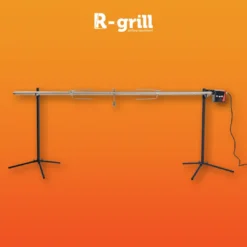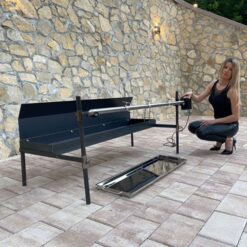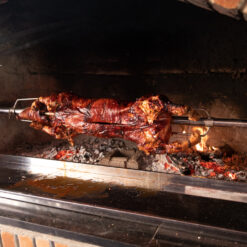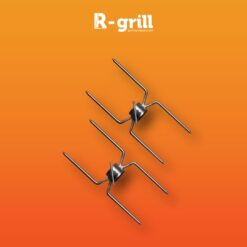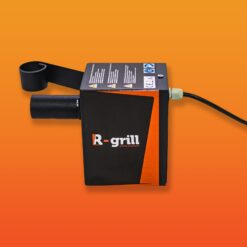
A rotisserie motor is strong enough if it turns your food smoothly under load without stalling or jerking. Raw power specs are less important than stability and balance. Prioritize a motor that offers safe mounting, steady rotation, and is rated for outdoor use. For more details, see our complete roasting guide.
Forget horsepower and torque specs for a moment. In the world of rotisserie cooking, “strong enough” is about performance, not numbers.
A capable motor turns the spit at a consistent, unbothered pace, even with a heavy, unbalanced load like a whole pig. There should be no stuttering, stalling, or jerking motions. Smooth rotation is the #1 sign of a motor that’s up to the task.
The motor should start turning the load from a dead stop without a struggle. Once it’s running, it should maintain its advertised RPM (revolutions per minute) consistently throughout the entire cook.
A whole animal roast can take over 10 hours. A good motor is designed for this kind of continuous use. It shouldn’t get excessively hot to the touch, emit a burning smell, or shut off unexpectedly.

It’s rarely the motor’s fault alone. These three factors have a huge impact on how much work the motor has to do.
An unbalanced load is the single biggest strain on a rotisserie motor. A 100 lb pig that is perfectly balanced is far easier for a motor to turn than an 80 lb pig that’s off-center. The lopsided weight creates a “kick” with every rotation, forcing the motor to work exponentially harder. Learn how to balance a whole pig or lamb on a spit.
Every point of friction adds to the motor’s workload. Worn-out bearings, a misaligned spit, or a slightly bent spit rod can dramatically increase the torque required to turn the load, making even a strong motor struggle.
Your setup’s environment plays a role. Strong winds can push against the meat, adding resistance. Grease and grime can build up in the motor’s moving parts, increasing friction. And while motors are built to be near heat, direct, intense exposure can cause them to overheat and fail.

A powerful motor is useless if the setup is unsafe.
The motor must be securely fastened to the rotisserie frame, and the entire frame must be on stable, level ground. A wobbly setup is a tipping hazard and puts unnecessary stress on the motor and spit.
This is a fundamental rule for any rotating equipment. The spit, forks, and motor create powerful pinch points. Keep a safe distance while it’s in operation.
Water and electricity are a dangerous combination. Never operate a rotisserie motor in the rain or on wet ground, and never touch it with wet hands. Always use a properly grounded outlet, preferably a GFCI (Ground Fault Circuit Interrupter) outlet, for outdoor cooking. Wear heat-resistant gloves when handling hot components, and never leave the setup unattended.
Your motor will give you clear signals when it’s struggling.
| Warning Sign | Likely Cause | Quick Fix |
|---|---|---|
| Stalling or Clicking | Load is too heavy or severely unbalanced. | Turn off, re-balance the meat, check for friction. |
| Jerky Rotation | Unbalanced load is “kicking” with each turn. | Re-center the animal on the spit immediately. |
| Excessive Heat/Smell | Motor is overheating from strain or internal failure. | Turn off, let it cool, check for obstructions. |
| Increased Wobble | Mounting bolts have loosened from vibration. | Turn off, let it cool, and tighten all connections. |


You can make a mid-range motor perform like a champion or kill a high-end motor in one cook—it all comes down to balance.
Once the animal is secured on the spit, place the spit on the supports. Let it rotate freely. It should settle with the heaviest side down. If it aggressively drops to one side, it’s unbalanced. Adjust the meat until it rotates with a more neutral, even feel.
If you notice a wobble, don’t ignore it. The fix is usually simple: re-center the animal, tighten the forks, or use a counterweight if your system has one. For a detailed guide, see our instructions on how to balance a whole pig or lamb on a spit.

Yes. If it stalls or turns unevenly, you’ll get a burnt, undercooked, and disappointing result.
Not necessarily. An oversized motor can’t fix an unbalanced load or a flimsy spit. It’s better to have a balanced system with a well-matched motor.
Balance. A perfectly balanced load on a good spit requires surprisingly little force to turn.
Don’t panic. Use heavy-duty gloves to manually turn the spit to prevent burning while you troubleshoot the motor, power, or balance.
It depends on the weight. A 120 lb pig requires a stronger system than a 40 lb lamb. Always choose a motor and rotisserie rated for your intended maximum load.
Ready to understand your equipment better? Here are the essential guides: